Saturday, April 17, 2010

Historical Background to Anglicanorum Coetibus

During a meal at Ushaw there was a conversation about Scotland and the Reformation as we quizzed one of our Scottish brethren about how it differed from that in England. During this conversation when it came to talking about James I and VI, I mentioned the proposal when he was king of England for reunification of the Church of England with the Catholic Church. No-one had heard of this and so I said I`d provide details here.

I am grateful to Mgr Gordon Read`s article in the December 2009 issue of the Canon Law Society Newsletter which in itself drew on an article in the Catholic Herald of 6th November 2009 by Fr Michael Rear.

Mgr Read writes:

Early in his reign James I wrote to Pope Paul V offering to recognize the spiritual supremacy of the Pope and to reunite the Church of England to Rome provided the Pope would disclaim political sovereignty over kings. Paul V took a tough line and condemned the oath of loyalty proposed by James I in the wake of the Gunpowder Plot. Urban VIII took a more conciliatory line: "We know that we may declare Protestants excommunicated as Pius V declared Queen Elizabeth and before him Clement VII the King of England Henry VIII....But with what successs? The whole world can tell. We yet bewail it in terms of blood. Wisdom does not teach us to imitate Pius V or Clement VII". Archbishop Laud of Canterbury mentions in his journal that on the day of his appointment he was offered a Cardinal`s hat.

Urban VIII sent a Benedictine monk, Dom Leander, to report on the state of the English Church.[....]

Leander suggested that the following measures might serve to reconcile the moderate Anglicans:

1. Communion under both kinds

2. Marriage of the Clergy

3. Liturgy in English

4. The admittance of English Protestant clergy to benefices (coming to agree in points of faith) either by conditional re-ordination or by way of `commenda`.

5. Permitting Roman Catholics to take the Oath of Allegiance to the monarch.

Later in the 1630`s Gregorio Panzini was sent to England as the Pope`s agent and negotiated for two years with King Charles I and various other parties.

The Jesuits were among those opposed to the plans! The Civil War put an end to negotiations. Charles II tried to establish religious tolerance and again there was a plan for reunification in 1663 which came to nothing. It would have allowed the king to nominate bishops, and for the Mass to be in Latin with English hymns.

I found all this very interesting in terms of how flexible the Holy See was willing to be to achieve reunification. Let`s hope Anglicanorum Coetibus is more successful than these previous attempts to accommodate an Anglican identity within the Catholic Church.

Friday, April 16, 2010

Thursday night and Friday morning at Ushaw

Slowly recovering after a week of thinking most of the time about rubrics at Ushaw.
Here is a picture from the conference dinner last night when Fr Elkin told us about life at Ushaw in the 1950`s. He received prolonged applause for his continued support for the Extraordinary Form.


This mornong we were addressed by Leo Darroch, the president of Una Voce International, who gave us the history of the organisation, and then by Joseph Shaw the chairman of the Latin Mass Society who had arrived the previous night. He spoke about some future projects of the LMS. After this Paul Waddington who had overseen the organisation of the whole event asked the participants for their opinions about what the conference and what could be done in the future.


After this came the final Mass of the conference, a votive Mass of St Cuthbert, celebrated by Fr de Malleray FSSP, with Antiphon singing the Palestrina Mass Aeterna Christi Munera which strangely was the same Mass setting we had for the recent Mass celebrated at Stella for the feast of St Cuthbert.

Thursday, April 15, 2010

Thursday at Ushaw

Requiem today. Yes I know the albs have lace and there are no unbleached candles on the altar. The Rudgate Singers sang the Victoria Requiem.

Wednesday at Ushaw continued

When I feel less exhausted I may write something about this week. In the meantime here are some more pictures. More can be found on the Middlesbrough LMS blog here.

Wednesday, April 14, 2010

Wednesday at Ushaw

All still going well. A few pictures from today. It`s been quite an exhausting day as there is a full timeatble. There was a free couple of hours this afternoon but I used it to go back to the parish to pick up a few things we needed and to call in at the North East Catholic History Society talk.

Tuesday, April 13, 2010

Tuesday at Ushaw

Just a few more pictures from today. Fr Elkin of Let the Welkin Ring was the celebrant of today`s Missa Cantata. Father is writing about the conference on his blog.

Monday, April 12, 2010

Monday At Ushaw

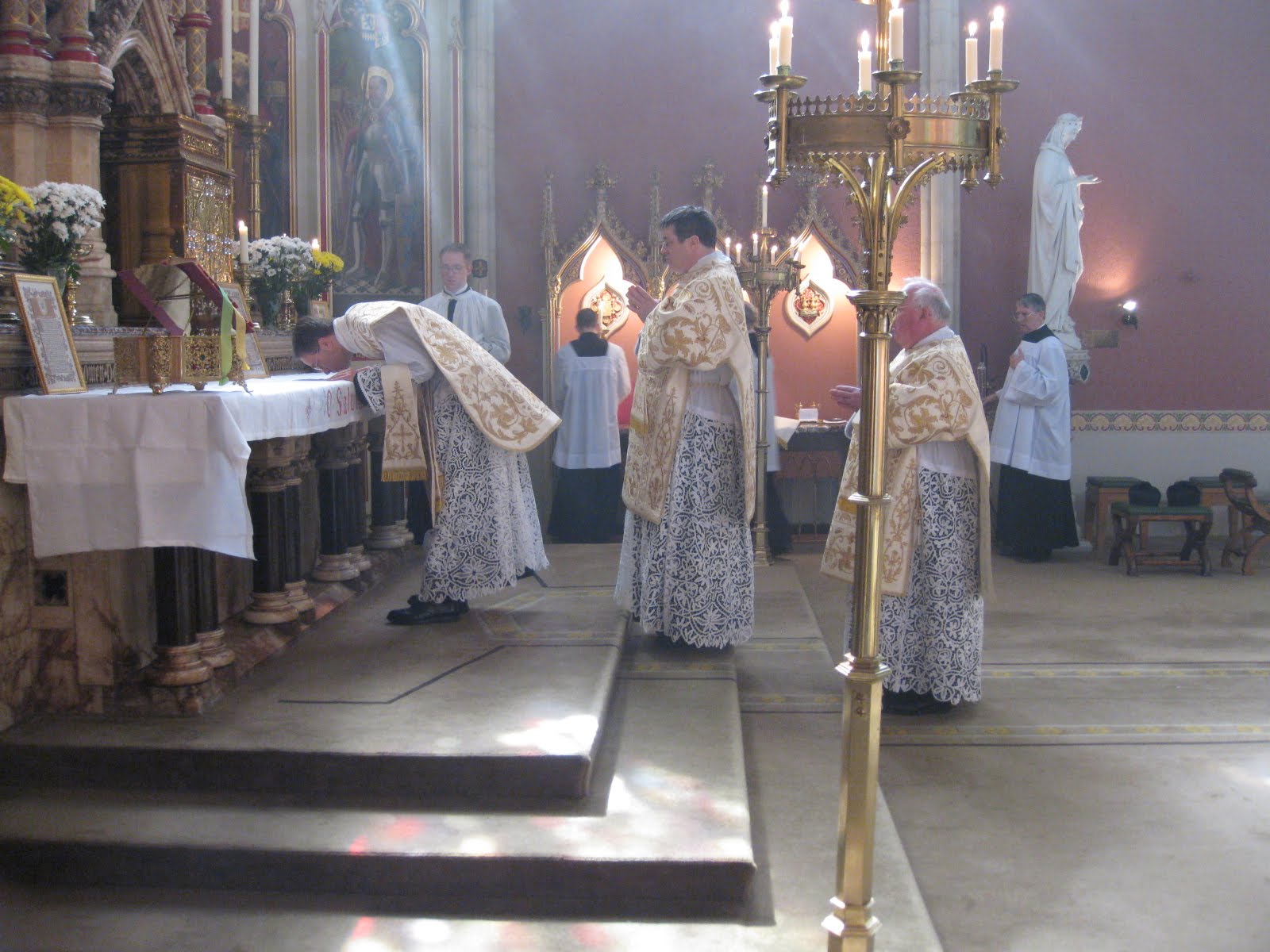
The first day of the LMS training conference has gone well. It`s good to see familiar faces from last year and new ones too. I had a bit of a rush to get here in time this morning and then go straight into High Mass. Here are some pictures that may be of interest.

Sunday, April 11, 2010

And so to Ushaw

Tomorrow I will go to Ushaw for the annual LMS training course for priests. I am looking forward to it immensely. Last year it was wonderful: even the weather was fabulous. The weather is looking good again and although things are never as good the second time it is hard to imagine how it would not be a great event. I am to be deacon at the High Mass tomorrow and celebrant of the Missa Cantata on Wednesday.

I would strongly urge priests and people who are not attending but may be interested to turn up for the daily public Masses. I thought I had posted the details but the Mass is either at 11 or 11.15 each day. Ushaw is a bit off the beaten track but it will be worth making the effort to be there.

I would also ask anyone who can to say a prayer for the success of this conference.

Saturday, April 10, 2010

The Tablet

This morning I heard the editor of the Tablet, Catherine Pepinster, being interviewed again on the Today Programme about the latest accusation against the Pope which the Vatican has defended itself. I didn`t listen too closely to what was being said as it sounded like many of the interviews I`d heard before.

However I was pleased to read an article in the Tablet yesterday by Fr Timothy Radcliffe with the title, `Should I stay or should I go` which I thought made many useful points, explaining why the present situation is not a reason for leaving the Catholic Church. Copyright prevents me giving the whole article but it is available on the Tablet site here.

However a couple of quotes will be useful:

...the statistics for the US, from the John Jay College of Criminal Justice in 2004, suggest that Catholic clergy do not offend more than the married clergy of other Churches.

Some surveys even give a lower level of offence for Catholic priests. They are less likely to offend than lay school teachers, and perhaps half as likely as the general population. Celibacy does not push people to abuse children. It is simply untrue to imagine that leaving the Church for another denomination would make one’s children safer. We must face the terrible fact that the abuse of children is widespread in every part of society. To make the Church the scapegoat would be a cover-up.


and

From the beginning and throughout history, Peter has often been a wobbly rock, a source of scandal, corrupt, and yet this is the one – and his successors – whose task is to hold us together so that we may witness to Christ’s defeat on Easter Day of sin’s power to divide. And so the Church is stuck with me whatever happens. We may be embarrassed to admit that we are Catholics, but Jesus kept shameful company from the beginning

I would like to hear Fr Radcliffe being interviewed on the Today Programme or Newsnight.

The Priest

I was delighted to receive in the post yesterday a complimentary copy of `The Priest` the journal of the Australian Conference of Catholic Clergy. This issue is dedicated to the conference in Rome I attended back in January and gives the texts of all the talks. I was so glad to have this as I didn`t take notes at the time and there were some things I wished I could remember from it. I see that past issues are available on-line and so this one should be too in time.

I`ve not looked at the ACCC site recently but I see they have a good selection of photos of the liturgies which are well worth a look.

All in all the ACCC is an impressive organisation ( as I`m sure their American counterpart the CCC is too). Wouldn`t it be great if we had a similar organisation in the UK?

Wednesday, April 07, 2010

ACN Pilgrimage to Walsingham

I`ve been sent these details about the forthcoming ACN pilgrimage to Walsingham which I`m happy to pass on.


Aid to the Church in Need UK – Annual Walsingham Pilgrimage of Grace – Saturday, 22nd May 2010, Feast of Saint Rita of Cascia


Please join us as Aid to the Church in Need remembers suffering Christians around the world with our 2010 Pilgrimage to the Roman Catholic National Shrine in Walsingham.


ACN is organising coaches from London Victoria. Should parishioners wish to join us at Walsingham, travelling independently or, perhaps, organising coaches from their locality they are very welcome to do so.


For those who would like to join us on this Pilgrimage and would like more information a booking form is downloadable from the ACN website at the following link. You could also contact us on 020 8642 8668.

http://www.acnuk.org/form.php/149/walsingham-pilgrimage-2010-booking-form

Sunday, April 04, 2010

Easter

While I`m waiting for the lunch to cook I thought I`d take the time to wish everyone a Happy Easter. I`m feeling rather exhausted just now and fell asleep last night watching an interesting programme on the Shroud of Turin. I`m sorry to have missed the ending and hope I can find it on one of those playback sites.

Maundy Thursday had a reasonable turnout of parishioners. I`m alway impressed by Catholics who come for this Mass as it is the least high profile of the Triduum ceremonies and people who come just want to enter into Holy Week as fully as they can. I failed to remember to buy a football rattle for the clapper used in place of bells at the consecration but I did have a plastic baby`s clapper thing which makes a suitable noise and I`m glad to say it was used to good effect.

Good Friday saw a large number of people at the Stations of the Cross at 10pm. I quite like to use the version by bishop Konstant on Good Froday but couldn`t find the book so we had the ones by Fr Cormac Rigby which I also like. Just before anyone is worried we did have the St Alphonsus Stations on two of the Sundays of Lent.

At 3pm we had the Solemn Commemoration of the Lord`s Passion and I was glad to see we had four altar servers turn up to help with the ceremonies. The church was full and all went well. At 5pm we had the same liturgy in the Extraordinary Form. This was thanks to the Jarrow men who offered to sing and who were helped by 1569 Rising and the former director of the now defunct Schola Gregoriana of Northumbria, Ian Graham. While I was worried about whether we would have enough servers, in the event we had four which was just about enough. The 3pm liturgy finshed just after 4 and we began rehearsing for the 5pm at 4.15. So I was delighthed that we had the resources to celebrate the Extraordinary Form and many thanks to all who helped. However it was rather sad that so few of the faithful availed themselves of this opportunity. From even among the avowed adherents of the Extraordinary Form in this diocese few came. Some preferred to attend the OF as they said the time of 5pm was inconvenient and others just didn`t seem interested.

The Easter vigil started at 8pm and despite a day of heavy showers the weather held to enable us to have the Easter fire outside. I hadn`t said anything to encourage people to make this their Easter Mass. It was a pity that not more came to this, the central liturgy of the Church`s year. Our music group had worked hard and did very well. I would say about 60-80 people attended and then we had refreshments in the hall with a simnel cake made by a parishioner and wine.

This morning although the promised sunshine didn`t happen, the church looked its best and was absolutely packed. I had said the 9.15 at Longbenton first where all went well. Then it was the 10.30 at St Mary`s. A rousing rendition of Thine Be the Glory concluded the Mass.

Monday, March 29, 2010

A Time for Contrition

I came across this article from the New York Times which seems more balanced than many I`ve seen. Just thought I`d mention it.

Tuesday, March 23, 2010

Holy Week

I`ve been asked if I`m celebrating any Holy Week liturgies in the Extraordinary Form. Thanks to the chant group from Jarrow I`m glad to able to say that there will be a Good Friday Commemoration of the Lord`s Passion according to the 1962 books at St Mary`s, Forest Hall at 5pm on Good Friday. However there will be no sung Mass for Easter Sunday at Longbenton although it is the first Sunday of the month.

In previous years we have been able to celebrate Tenebrae but this year that will not happen. Most of the schola who were involved have moved away from Tyneside over the last few years and the reinforcements from north of the border are now in the happy position of being asked to sing Tenebrae in the cathedral in Edinburgh. Congratulations to Alan and the St Margaret Schola of Edinburgh (which has a blog here) : I hope all goes well.

A list of Holy Week liturgies in the Extraordinary Form taking place in England and Wales can be found here thanks to the LMS. It is good to see there is so much on offer.

Sunday, March 21, 2010

Mass at Stella

Thanks to Frank Erskine for sending these pictures of yesterday`s High Mass for the feast of St Cuthbert. There was a good turn out for the Mass and the it was good to have the choir of St George`s, Cullercoats, to sing for us. The choir enjoyed singing this music in the context for which it was written and we look forward to hearing them sing again at a future Mass. Fr Swales was the celebrant, I was the deacon and Fr Phillips, the parish priest, was the sub-deacon. Seasoned viewers of pictures from the world of the Extraordinary Form may recognise the MC: Leo Darroch, the president of Una Voce International.

Friday, March 19, 2010

Sunderland man becomes bishop

Just thought it may be of interest to readers to know that the new bishop of Gibraltar who was announced yesterday is a native of Sunderland.

The following appeared on the Vatican Information Service site yesterday regarding papal appointments:

Appointed Fr. Ralph Heskett C.Ss.R. delegate for vocations for the Redemptorist province of Great Britain.The bishop-elect was born in Sunderland, England in 1953 and ordained a priest in 1976. He succeeds Bishop Charles Caruana, whose resignation from the pastoral care of the same diocese the Holy Father accepted, upon having reached the age limit.

Monday, March 15, 2010

Catholic Triumph at Durham

Another story I`d been meaning to draw attention to I first saw in the Tablet but I also see gets good coverage in the Northern Cross. Readers will remeber the Intelligence Squared debate in London last year where the motion that `The Catholic Church is a force for good in the world` was overwhelmingly defeated. Then there was the more recent debate, hosted by the Spectator, on the motion that  `England should be a Catholic country again` where the motion was carried by Cardinal Murphy O`Connor, Piers Paul Reid and Dom Anthony Sutch. Now we have had a similar debate at Durham university on the motion `This house believes that Catholic morality has no place in the 21st century`. Speaking for the motion were Dr Julian Baggini, an atheist and editor of The Philosophy Magazine and one Thomas Ball. Speaking against were the university Catholic chaplain, Fr Tony Currer and Chris Lamb of the Tablet.  Fr Currer has written an account of the proceddings in this month`s Northern Cross  (p.6). He made the point that the bedrock of Catholic teaching is the innate dignity of the human person and that the biggest afront to human dignity is poverty, injustice and warfare. That seemed to do the trick as the motion was defeated. Congratulations to Fr Currer and Chris Lamb.

Fame at Last!

I must have had Blogger`s Block or something but I have been meaning to get around to a few things and never have managed it. However just to say that Forest Murmurs this month reached the height of its fame in that it was quoted on the front page of the Northern Cross, our diocesan newspaper, in the lead story about the reception of Anglican bishop Paul Richardson, into the Catholic Church. Normally the front page of the NC is made available by the diocesan website, each month but this month that is not to be so I can`t let you see it. Apparently this is because Paul Richardson wants to keep his reception fairly quiet, even though I first saw the story in the Daily Telegraph! Does this mean the Northern Cross has a bigger circulation than the Telegraph?!

Anyway I`m grateful to the Northern Cross for a mention. The second last paragraph quotes me when I spoke about hearing the former bishop preach at St John`s in Killingworth. Maybe I should also mention that this month sees the new-look Northern Cross with full colour on every page. There is a website here with some very jaunty music.

Thursday, March 04, 2010

Mass for St Cuthbert`s Day at Stella

A group of priests of the diocese are arranging a High Mass in the Extraordinary Form at the church of  St Mary and St Thomas Aquinas at Stella, near Blaydon for St Cuthbert`s day ( March 20th). Mass will start at 12 noon and the music for the ordinary of the Mass will be Palestrina`s Aeterna Christi Munera setting which will be sung by the choir of St George`s, Cullercoats. This should be a splendid occasion and an opportunity to visit one of the most historic churches in the diocese for anyone who hasn`t been there before.

Here`s some information about the parish culled from `Down Your Aisles` by Michael Morris and Leo Gooch.

The earliest record of a Catholic presence at Stella is in 1149 when the bishop of Durham granted the manor of Stella to the Benedictine nuns of Newcastle as a summer retreat and a source of income. Stella Hall was created after the dissolution of the monasteries but was built by a Catholic, Nicholas Tempest. In 1598, the bishop of Durham writing about Catholic activity in his diocese wrote `Nicholas Tempest of Stella, that great recusant... where at Stella, if I am rightly informed, they keep up a Popish spiritual service`.

A priest was in residence at the hall throughout the penal period with Benedictines and Jesuits serving as chaplains. An interesting point to note is that the name of the tune for `Hail Queen of Heaven` is Stella because it was composed there.

The church opened on October 12th 1831 and was designed to seat 300. A three part Mass ( by Webbes) was sung with full orchestral accompaniment, preceded by the overture to the Messiah and terminated by the Hallelujah Chorus! The church is notable for the design of the presbytery which is added as a kind of facade to the church so that from the road it looks like a castle more than anything, presumably so as not to alarm any passing Protestants. Stella Hall itself was demolished in 1954. Four daughter parishes have been founded from Stella.

Saturday, February 27, 2010

North East Catholic History Society

I`ve remembered to give a little more notice for the next meeting this time. The next talk will be on Wednesday 3rd March at 2pm at St Andrew`s, Worswick Street, Newcastle. The talk was meant to be given by Mr George Thornton on the topic of St Robert of Newminster and the Early Cistercians. However Mr Thornton has had to withdraw this time for personal reasons and we are fortunate that Dr Leo Gooch can step in to give a talk on Lord Lumley (1537-1609) who is the subject of his latest book.

Big Surprise?

Rorate Caeli reports a rumour seen on a Spanish blog that the Holy Father will, during Holy Week,  unveil a surprise which will be for the good of the whole Church. It is speculated that it could be the withdrawal of the indult for Holy Communion in the hand or that the Pope will celebrate the Mass that day in the Extraordinary Form. The day suggested for this is Maundy Thursday.

I`m slightly worried because Maundy Thursday is April 1st! Let`s hope the announcement is made in the afternoon.

Friday, February 26, 2010

Sainte-Marie de La Garde

Thirteen monks from the abbey of Sainte-Madeleine du Barroux, near Carpentras, which I first had the joy of visiting in 1984 ( it had its origins in 1970 as an extraordinary form monastery), were sent by their abbot in 2002 to found the new monastery of Sainte Marie de la Garde near Agen. I mention this as they offer a widget which apparently allows you to be united with the monks in prayer as it rings a bell for Lauds, Sext and Vespers. This is offered as an opportunity to live your Lent according to the routine of the monks of St Marie de la Garde. Apart from anything the site offers information on the building of the new monastery. Makes a nice change from continuing stories of closure.

Tuesday, February 23, 2010

Mystified

I`m sorry but I don`t understand how a Catholic school can provide information about how to have an abortion. According to canon law, anyone whose co-operation in procuring an abortion is an essential part of it coming about incurs an automatic excommunication.

I look forward to hearing how this can happen in a Catholic school.

Thursday, February 18, 2010

Former assistant bishop of Newcastle becomes a Catholic

I read last night on Damian Thompson`s blog about bishop Paul Richardson, the former assistant bishop of the Anglican diocese of Newcastle, being received into the Catholic Church at Durham university Catholic chaplaincy last month. (The Telegraph also has the story.) I came across him in 2007 at the induction of the new vicar of Killingworth back in September 2007 and blogged about how impressed I was by his sermon on St Gregory the Great. I`m only sorry to read that he no longer lives in the North  East but in London. Damian also reports that Paul Richardson has said he is not looking to be part of the ordinariate which is a shame given the provision for former Anglican bishops to maintain their episcopal insignia which is one of the more intriguing parts of the provision.

Congratulations to the former bishop!

Wednesday, February 17, 2010

Lent Retreat

Fr de Malleray is giving a retreat for lay people next month. Full details below.

Come and meet us soon at the Lenten week-end of recollection: 5-7 March 2010
on ‘The Four Last Things: Death, Judgment, Hell and Heaven’.

*Address: All Saints Conference Centre, Shenley Lane, London Colney, Herts, AL2 1AF.
*Website: www.allsaintspc.org.uk.


*Starts on Friday 5th March 2010 at 5pm (later arrival possible) – ends on Sunday 7th March 2010 at 4pm.
*Holy Mass in the EF on Friday afternoon, Saturday and Sunday.


*Confession / spiritual direction on request.


* Retreat Master: Fr Armand de Malleray, FSSP

*Price: £126 everything included (for: £116 as Centre’s fees + £10 as FSSP fees).


*Please bring your traditional hand missal + your own towel and soap.


*Booking: please send to us a £15 deposit cheque made payable to FSSP ENGLAND. Please kindly book now.


Fr Armand de Malleray, FSSP


Priestly Fraternity of St Peter in England

179 Elgar Rd, RG2 0DH, Reading, Berkshire, UK


Tel: +44 (0)118 987 5819 - E-mail: malleray@fssp.org -


Community: www.fssp.co.uk - Youth: www.juventutem.org - Culture: www.lartpourlame.com


FSSP England is a registered charity n° 1129964

Tuesday, February 16, 2010

Pilgrimage to Lyon and Ars

On Monday I set out for Stanstead to meet the rest of the party of priests heading out to Lyon for a pilgrimage under the direction of Fr de Malleray of the FSSP. After an epic journey from Lyon airport which took three hours using a bus, tram, underground and (very crowded) bus again we reached our base: the FSSP house at Francheville on the outskirts of the city. This house also accomodates a small primary school and when we arrived workmen were still busy on the refurbishing of the house. It is dedicated to St Padre Pio and has a rather nice stained glass window in the chapel dedicated to him. On the hill behind the house is a seminary of the diocese of Lyon which is now up for sale.

On Tuesday morning we woke to find it was snowing: it continued to snow most of the day. I had hoped to leave the snow behind in England!  Our programme began with a visit to the Gallo-Roman museum which was quite spectacular. There was a special exhibition on Roman burial rites which was very well done. After this we made for the basilica of Notre-Dame de Fourvière, which has one of the most breath-taking interiors I have ever seen. After a bouchon lunch we headed off to see the church of St Georges where the FSSP had their original apostolate in Lyon, the cathedral of St John the Baptist and the church of St Nizier which was built on the site of the first Christian place of worship in the where Mass was celebrated from 150AD.

On Wednesday we had a day of silent retreat in the house. Fr de Malleray gave us four conferences on the priestly life and we had readings at meals from St Pius X`s exhortation on the priestly life Haerent animo. Fr de Malleray recommend to us Bl. Columba Marmion`s Christ the Ideal of the Priest as the best book he has read on the priesthood. I have had a copy for many years and intend to read it in this Year of the Priesthood. Father`s talks were both practical and challenging and gave me at least, much food for thought.

On Thursday we headed of to Ars for the day. I`m delighted to report that not only was there no problem arranging for our group to celebrate the EF in the church at Ars but the sacristy even provided altar cards and missals. As we entered the church I could hear a Missa Cantata being celebrated on the altar above which the body of the saint is on display. This was being celebrated by a priest of a new group, the Missionaries of Divine Mercy from Toulon,  which seem to be modelled on the White Fathers. There were a number of priests of the group with a large group of faithful. I`d never been to Ars before and hadn`t realised that while the nave of the original parish church has been preserved the sanctuary has been removed and replaced with a much larger, elaborate one which included the shrine of the saint on the right hand side. This shrine is not visible from the old nave. In the sacristy the first four of our group prepared to celebrate their Masses. I was lucky to be allotted the altar with the relic of St John Vianney. Once I left the sacristy and entered the new part of the church I caught sight of the altar for the first time and found it a most moving experience to see his body above the altar. There is not a lot to see in Ars but we made a visit to the presbytery where the saint lived. Later in the day the archbishop of New York and a group of his priests celebrated Mass at the altar of the saint. I looked through the book in the sacristy where priests who have said Mass sign and saw there had been a group of priests from Hexham and Newcastle there a fortnight before our visit and also a pilgrimage of priests from Nottingham diocese with their bishop had been in January.

And so on Friday afternoon we left Lyon ( and the snow) to return to England. I am so glad to have had the opportunity to visit Ars in the Year of the Priest and seek the intercession of St John Vianney, the patron saint of parish priests. Many thanks to Fr de Malleray for organising it and making it possible.


News from Ecclesia Dei

For anyone who missed yesterday`s clarification from Ecclesia Dei yesterday, these are the five points which were clarified in a response to the diocese of Rzeszów. ( Many thanks to the NLM for this.)

1. If there is no other possibility, because for instance in all churches of a diocese the liturgies of the Sacred Triduum are already being celebrated in the Ordinary Form, the liturgies of the Sacred Triduum may, in the same church in which they are already celebrated in the Ordinary Form, be additionally celebrated in the Extraordinary Form, if the local ordinary allows.

2. A Mass in the usus antiquior may replace a regularly scheduled Mass in the Ordinary Form. The question contextualizes that in many churches Sunday Masses are more or less scheduled continually, leaving free only very incovenient mid afternoon slots, but this is merely context, the question posed being general. The answer leaves the matter to the prudent judgement of the parish priest, and emphasises the right of a stable group to assist at Mass in the Extraordinary Form.

3. A parish priest may schedule a public Mass in the Extraordinary Form on his own accord (i.e. without the request of a group of faithful) for the benefit of the faithful including those unfamiliar with the usus antiquior. The response of the Commission here is identical to no. 2.

4. The calendar, readings or prefaces of the 1970 Missale Romanum may not be substituted for those of the 1962 Missale Romanum in Masses in the Extraordinary Form.

5. While the liturgical readings (Epistle and Gospel) themselves have to be read by the priest (or deacon/subdeacon) as foreseen by the rubrics, a translation to the vernacular may afterwards be read also by a layman.

I can think of a number of parish priests of my acquaintance who will feel supported by this as they have introduced an EF Sunday Mass where there was an OF one before. It is also very useful to read that a parish priest may introduce an EF Mass without waiting for a request from a `stable group`.

Saturday, February 13, 2010

Ushaw Conference

I received this notice from the LMS regarding the forthcoming Ushaw training conference. I`m sorry to hear that there have not been so many applications so far. It was a marvellous week last year and I hope we can repeat it this year. Even if many priests learnt how to celebrate Low Mass last year, surely there must be still quite a few who would enjoy learning how to celebrate Missa Cantata or how to be a subdeacon or deacon at High Mass.Apart from anything there was the company of good priests and wonderful liturgies and the splendid architecture of Ushaw. There is also a notice about training for Masters of Ceremonies.

Latin Mass Society
Priests’ Training Conference
Ushaw College
12th to 16th April 2010

The Latin Mass Society has announced that, although a good number of bookings have been received for the Priests’ Training Conference to be held at Ushaw College in Co Durham during Low Week, about 12 places are still available; and it is expected that these will be taken in the next few weeks.

The conference will provide tuition for priests wishing to learn to celebrate Mass in the usus antiquior, or traditional form, with classes for beginners and more advanced students, as well as those wishing to learn to sing at a Missa Cantata or to celebrate a Solemn Mass. The conference will also include a range of liturgies which will be examples of best practice in the traditional rites. There will also be a spiritual lecture.

Ushaw College is an ideal location for this conference because of the range of facilities it offers, including numerous chapels and side altars for practice Masses. A schola and polyphonic choir will be in attendance to provide the music at all services which will take place in the magnificent St Cuthbert’s Chapel.

As an innovation this year, a simultaneous course will be run for servers wishing to learn how to be an MC at a Missa Cantata or Solemn Mass. Applications are invited from men or boys who already have a basic knowledge of how to serve at Low Mass.

The conference fee is £115 inclusive of full board and lodging. Further information and application forms can be obtained from:
The Latin Mass Society
11 -13 Macklin Street
London WC2B 5NH
020 7404 7284
thelatinmasssociety@snmail.co.uk


Latin Mass Society
Training for Masters of Ceremonies


The Latin Mass Society will be providing training for men and boys who wish to learn to be Masters of Ceremonies at Sung and Solemn Masses. The first training course will take place during the Priests’ Training Conference which will be held at Ushaw College in Co Durham from 12th to 16th April 2010. A further training opportunity is planned for later in the year in a more southerly location.

The rubrics of the Roman Rite require that there is a Master of Ceremonies at a Missa Cantata and at a Missa Solemnis. It is his job to take charge of all that happens on the sanctuary, including giving discreet directions to the priest. In the case of a Solemn Mass, there is also a deacon and a sub-deacon and generally more servers who may require some supervision. This requires a level of knowledge of the rubrics far in excess of that needed to serve at a Low Mass. It also requires a degree of confidence beyond that of ordinary servers.

As more priests are being trained in the usus antiquior, and more Masses are occurring in the traditional rite, the shortage of servers is becoming more acute. This is especially so in the case of Sung Masses which require a greater number of servers, and also servers with greater skills. At present, it is very difficult to find a well qualified and experienced MC in most parts of the country.

Men and boys who have already mastered the art of serving at Low Mass, and who think they may be able to cope with the job of MC, are invited to attend one of the training sessions. In the case of the one at Ushaw College, which is residential, there would normally be a fee; although in cases of hardship, this may be waived.

Contact: The Latin Mass Society
Tel 020 7404 7484

Fr Carola`s Book

I got back last night from Lyon where I had been with eight other  priests from England on a pilgrimage/retreat led by Fr de Malleray FSSP. I hope to write a report soon. Among my emails I found one from the Midwest Theological Forum with the news that Fr Carola`s book which I mentioned in writing about the Rome conference is available from their website for $10. You can find the details here.

Sunday, February 07, 2010

Lent Course

Last year I reviewed bishop O`Donoghue`s Fit for Mission? Church for the LMS magazine Mass of Ages. This year I`m proposing to see how it works and to run it as a Lent course for the parish. Meetings will take place on the Thursdays of Lent at 7.30pm at St Mary`s and I hope we have some lively discussion and deepening of our understanding of the faith in a relaxed atmosphere.

Saturday, February 06, 2010

Rome Conference Day 4: the talks, Day 4

Sorry to say that this blog has somewhat ground to a halt over the last couple of weeks. Part of the problem was thinking about this post. The trouble is that I never thought to take notes during the conference. If I had thought about it at all I would have realised I should have for the purposes of blogging but I hadn`t given any thought as to how I was going to write about it.

So here goes with the fourth day. The first talk was given by the Irish Dominican, Fr Paul Murray. I had first come across Fr Murray at Ushaw in probably 2001 ( although I could be wrong on the date) when he gave the annual retreat to the priests of this diocese. I remember enjoying his talks more than I usually enjoy these things and was delighted to see him in this context. I had the chance to talk to him a couple of times during the week and found him most encouraging. Father`s talk to us was entitled `Preaching to priests: wisdom from the Middle Ages` in which he focussed on St Bernard of Clairvaux and St Catherine of Siena.

The next talk was gioven by Fr Paul Gunter, a monk of Douai who is a professor at the Pontifical Institute S. Anselmo in Rome as well as Consultor of the Office of the Liturgical Celebrations of the Supreme Pontiff since 2008 and a member of the Editorial Board of "Usus Antiquior", a journal dedicated to the Sacred Liturgy. Father spoke on `The Genius of the Roman Rite in the identity of the priest` the first half of which was devoted to looking at the work of the nineteenth century liturgist Edmund Bishop in identifying the `genius` or guiding spirit or essence of the Roman Rite, which was the subject of his doctorate. The second half of the talk I mainly remember for the happy way it spoke of the Extraordinary Form as much a part of the everyday life of the modern church as the Ordinary Form of the Roman Rite.
Apologies to both speakers for my sketchy recall of their talks. I did have a conversation with Fr Gunter after his talk and was impressed by his knowledge of all the parishes in Hexham and Newcastle which were formerly staffed by Douai monks and the details of the church buildings with their good and bad points.

That was the last of the talks in the conference. At 11.30 we split into national groups to discuss what we could do next.

Thursday, February 04, 2010

Latin Mass Society Full-Time General Manager

From the LMS.

The LMS wishes to appoint a full-time General Manager will be responsible for the day to day administration and development of the Society as directed by the Committee. The post is based in the LMS’s office in Holborn, London WC2. Applicants will have excellent managerial and communication skills and a proven track record of success. They will also have a knowledge and love of the Traditional liturgy and movement. The salary and pension package is in the range of £35K to £40K.

Much of the work involves the co-ordination and organisation of flagship national/international events including training conferences, the LMS AGM and the production of the annual Accounts, major Masses and liturgical events with national importance. It also involves maintaining and developing contacts with the hierarchy, diocesan authorities, Traditional Catholic bodies in England and abroad and the Traditional priestly and monastic orders. The General Manager will develop the LMS’s Seminarians Fund in order to assist vocations.

The General Manager will also make strategic recommendations to the Committee, particularly concerning development, the generation of increased publicity, membership and income, and the timely control of expenditure. He/she will oversee and administer legacy generation work and will support the Society’s network of diocesan representatives.

This position will entail some evening and weekend work, and travel, both UK and internationally.

A job description and details of the application process are available from the LMS office at 11-13 Macklin Street, London WCB 5NH. Tel: 020 7404 7284.

E mail: info@latin-mass-society.org

The closing date for receipt of applications is Thursday 4 March 2010. Interviews will be held in London from mid to late March.

British government retreats after Pope's critique of Equality Bill :: Catholic News Agency (CNA)

British government retreats after Pope's critique of Equality Bill :: Catholic News Agency (CNA)

For a useful look at the issues see this article by Br Lawrence Lew OP.

Sunday, January 24, 2010

Mgr Marini and Forest Hall

Today the bishops of England and Wales set off for Rome for their ad limina visit where they submit reports about their dioceses and discuss them with the various Vatican departments. I`m sure our prayers will be with them that the whole process will be helpful in strengthening the Church in England and Wales. The Scottish bishops follow next month.

As bishop Seamus Cunningham goes off he has two saintly predecessors who made the journey before him when travel was not quite so easy: St Wilfrid and St Benet Biscop. These two Northumbrian saints made many visits from this part of the world to the Holy See. St Benet Biscop mainly seems to have gone for the shopping in that he brought back items to enhance the life and worship of the monasteries of Jarrow and Monkwearmouth. His greatest coup was to persuade John the arch-cantor to leave St Peter`s, Rome and come to these Monkwearmouth to teach the monks how to sing chant in the authentic Roman way. This is a recurring obsession of mine and I see I blogged about it just over a year ago.

Well, this weekend at St Mary`s Forest Hall the words of Mgr Marini, the papal MC were heard at Mass. I read out part of the talk we had heard at the conference: the part on active participation. I`ve been keen to share something of that talk with the parish since getting back and the Mass readings at the OF seemed to lend themselves to the topic as we had St Paul`s first letter to the Corinthians on the complementary roles of the members of the Church while the first reading from chapter eight of Nehemiah and the Gospel from Luke chapter four (14-21) laid the ground for talking about the liturgy.

I mentioned in a previous post the whole talk can be found here.

Why I mention this is that I was quite tacken aback by the reaction afterwards. Normally I don`t get much reaction or if I do it is people wanting to disagree with me. This morning it was different, people were queuing up (well not quite) to say how much they enjoyed it. Even one of my regular critics said it was so good to hear something like that from the pulpit. (We don`t have a pulpit but it, like altar rails, seems to have stuck in popular ways of referring to church life.)

I was so glad that there was such a warm response to Mgr Marini`s words. I`m now thinking of sharing what he said about music and adoration and may get on to his section on orientation and liturgical prayer.

New Priest Blogger

As others have commented, in this year`s message for World Communications Day, the Holy Father has encouraged priests to use blogs and other modern means of communication to promote `dialogue, evangelization and catechesis`.  I am glad to say that another priest of Hexham and Newcastle, who has always kept up with new technology, has started a blog. Fr Elkin is parish priest of Barnard Castle in Co Durham. His blog is called Let the Welkin Ring.

Fr Elkin started saying the Extraordinary Form again in about 1994 if my memory serves me right, helping with Masses at St Dominic`s in Newcastle where the `indult Mass` had been established on a Sunday in 1992. I`m glad to see that his latest post is a reminisence about his time in the priesthood. It must have been in about 1995 I had the privilege of celebrating a Missa Cantata at St Patrick`s, Consett. The large church was packed and the Missa de Angelis sung lustily by a full congregation raised the roof: I`ve never heard anything like it since. Unfortunately there was never another EF Mass again at St Patrick`s. However Fr Elkin preached and he spoke about an issue that always fascinates me: what were the hopes of young priests for the liturgy in the 1950`s and 1960`s? Basically Fr Elkin described how he had been full of hope for a great revival of the faith through the introduction of the vernacular and other reforms but how disillusionment set in and how he has happy to come back to the Latin Mass. I hope I`ve got the drift of this right and hope Father will maybe blog on this topic now he is reminiscing.

I hope to be finishing of my account of the talks at the Rome conference very soon.

Thursday, January 21, 2010

Rome Conference Day 3: the talks, Day 3

This is all taking me longer to get round to writing up than I imagined. On the third day we had two talks. However the day had to be re-arranged in that we were supposed to be having EF Vespers in the church of St Stephan of the Abyssinians in the Vatican but since it was discovered that the Abyssinian church was closed with the Epiphany being a holiday in the Vatican, Vespers were re-scheduled to be in the FSSP church of Santissima Trinita dei Pellegrini which I had wanted to see any way. This meant that Fr Lang`s talk on the new translation of the OF missal had to be moved to after dinner. Fr Lang works for the Congregation for Divine Worship.

So the first talk of the day was given by Mgr Guido Marini, the Pope`s Master of Ceremonies. Monsignor does not speak English well enough to give talks in it so he spoke in Italian. However he spoke so clearly and calmly that this listener whose Italian is rather rusty was able to understand almost everything. An English translation of the talk had been prepared the day before and copies were available for people to follow. Much has already been written on the internet about this talk which was entitled Introduction to the Spirit of the Liturgy. It is available here. This talk was the highlight of the conference for me and I`m sure for many others. It was wonderful to hear about the ideas for the `reform of the reform` from one so close to the Holy Father. Many of the conference members had commented how the morning`s Mass with the Pope in St Peter`s had shown how far things had come in quite a short time in improving the qualilty of papal Masses. At the end of the session the conference gave Mgr Marini a standing ovation. I`m hoping to share some of the ideas from his talk with the parish to introduce some of the principles governing modern liturgical thought.

After dinner we had Fr Lang`s rescheduled talk. This was the most intellectually demanding talk of the week and as it did not start until after 9pm some of the Fathers were beginning to wilt after a long day. Fr Lang`s talk was entitled Liturgy and language: The "Sacral Vernacular" (Liturgiam authenticam 47) of the new English Translation of the Roman Missal. Father began by demonstrating the nature of sacral language in the Roman Rite, referring to the work of Christine Mohrmann. In the second part of the talk, Father took us through the new translation of the first half of the Roman canon explaining each section. The text has been available on the internet for quite a while now. It will be wonderful to use a translation which is close to the original instead of the current version. Talking to many priests there is some reluctance to embrace the new translation but then religions tend to be conservative. At seminary I lost count of the number of times we were quoted Newman`s saying about to live is to change! Any liturgical change always arouses opposition but surely it is better to have a translation of the Mass which is accurate and captures the spirit of the original rather than our current version which used the now discarded notion of `dynamic equivalence`

Father Lang was unable to say exactly when the new translation will come into use. It was hoped that it would be ready by 2010 but it looks as if it will now be Advent 2011. That at least gives time for preparations to be made to introduce it to the clergy and faithful. In the question session one priest voiced my thoughts when he said how much training does there need to be for someone to read a text? It is hard to see what the training for using the new missal will involve: not all priests will have the linguistic background to enable them to appreciate what has happened and there is no question of the new translation being the subject of debate as it is definitely going to happen. However it will be useful to have an opportunity for things to be explained as far as they can given the level of anxiety there appears to be about it all.

Saturday, January 16, 2010

Rome Conference 2: the talks, Day 2

When looking at the conference programme before setting off I saw that the first morning was due due to begin at 8.30am with a lecture on Three Patristic Texts on the Priesthood. This looked like a daunting topic for an early morning start. However Fr Carola`s talk brought to life the teaching of Ss Gregory Nazianzus, John Chrysostom and Gregory the Great and made them relevant to our age and situations. Fr Joseph Carola SJ has been Professor of Patristic Theology at the Gregorian University (in Rome) since 2002. When the opportunity for questions came after the talk the topic of priests facing a crisis in their vocation and leaving active ministry came up. Fr Carola spoke of how quite a number of his former pupils at the Greg have left active ministry. It is a question of knowing that a priest will eventually face a crisis and for there to be support systems to help a priest at that stage to help him get over this and remain faithful to his vocation. Unfortunately this is still not well provided for and priests are left to sink or swim. I`m glad I was one of the many who bought a copy of Fr Carola`s new book ( just published this month) entitled Conformed to Christ Crucified: Meditations on Priestly Life and Ministry which consists of Father`s sermons and reflections on this theme. The book is published by the Gregorian and Biblical Press.

Next we heard from Fr Dodaro OSA the director of the Patristic Institute Augustinianum in Rome. His talk was entitled The Priest as sinner in the thought of St Augustine and dealt with the Donatist view of the clergy as spiritual superstars such that if a priest was found to be less than perfect it greatly troubled the Donatist laity as for them the efficacy of the sacraments if not their validity depended on the sanctity of the minister. While it is easy to fall back on the theory of ex opere operato, Fr Dodaro spoke of Augustine`s awareness of the priest as sinner and the need to avoid putting the priest on a pedastal in today`s Church. There must be a way for the priest to convey that he too needs forgiveness from God and needs the prayers rather than praise of his congregation.
The third talk of the morning was by Mgr Feichtinger of the CDF who spoke on The Hermeneutics of the Inquisition which was not as might be deduced from the title a look at the work of the CDF but an exploration of the philosophical background to the `Hermeneutic of Continuity`.

In the evening, after dinner (where we were joined by the Australian ambassador to the Holy See) we were treated to a talk by Blackfen`s Fr Tim Finigan ( pictured above in mid-speech). Fr Finigan`s experiences as a seminarian seemed familiar to the conference. (`Take a stone out of a bag and pretend you are that stone and what do you want to say` etc) He recounted a visit by Mother Teresa to the English College where she caught sight of what was the must-have book of the time, `I`m OK. You`re OK` which moved her to say `Well I`m not OK and you`re not OK. That`s why we need Jesus.`! Fr Finigan echoed the thought I often have ( and the last words I ever said to bishop Kevin Dunn before his death) which is that I wake up every morning and no matter how bad the weather or whatever problems there are, I thank God that Ratzinger is Pope. Father also asked us to thank God for Pope John Paul II who started the fight back against the collapse of the Church. Father`s speech was very warmly received.
And after that I retired for the night.

Wednesday, January 13, 2010

Rome Conference 1: the Talks, Day 1

Sorry to have been so slow to getting down to writing about the conference for English-speaking priests in Rome last week. I think it was only on Tuesday that I recovered from the 3am start we had to make on Monday 3rd January to get the 6am flight from Newcastle to Amsterdam and from there to Rome. (I went with another priest of this diocese who prefers not to be named.) There is only a direct flight from Newcastle in the summer nowadays. Although I slept most of the flight it never seems to make up for getting up in the middle of the night and once we got to the conference the pace was quite intense so I was mainly operating on adrenalin. However there was a lot going on to keep the adrenalin flowing.

After an introduction to the conference by Frs John Trigillio and John Walsh (chairmen of the CCC and ACCC respectively) we had Vespers in the Domus chapel at 5.30pm. I`ll be doing another post about the liturgies. This was OF Vespers in English celebrated with the Blessed Sacrament exposed. It was our first encounter with the Lassus Scholars who provided the music during the week and from the start we knew that we were in for a musical treat. They sang a Lassus Magnificat. However I`m trying to stay away from talking about the liturgy. The sermon was given by Bishop Geoffrey Jarrett of Lismore, Australia. What I enjoyed about this was that bishop Jarrett soon made it clear that he had suffered what we had suffered. It was encouraging to hear a bishop talk like this and I think it is the first time I`ve heard a diocesan bishop talk like this. Bishop Jarrett is a member of the ACCC so it should have come as no surprise but I`m so used to hearing how wonderful everything is from bishops that it was at the very least refreshing to hear a different point of view and one which reflected much of my and I`m sure most of the other particpiants` experience of life in the church as regards problems over catechesis and all the rest.

After dinner there was a talk by Mgr McDaid of the Congregation of Clergy which was probably the most stirring talk of the conference. He clearly had faced the same obstacles as many of us. He sounded the theme which was to be taken up by many talks during the week: that the priest is to be conformed to Christ. For couples who wanted to know how to be good parents his advice was that they love one another. For the priest his advice was to love God. I didn`t take notes but I think I remember him talking about a lady in a position of responsibility in the Church who made it known that she did not believe in the divinity of Christ. If anyone challenged this they were accused of having problems with relating to women! (I hope I have this right: if anyone can tell me if I`ve not, then do let me know.)
There was an oppprtunity to enjoy the first convivium of the conference after this but after such a long day I couldn`t wait to get to my bed.

Friday, January 01, 2010

Habemus Papam


I spent New Year`s Eve with two friends, one of whom kindly cooked an Indian meal for us. I should have taken some pictures à la Fr Z. After this we played the board game Vatican ( `Unlock the secrets of how men become pope`). I`d bought this quite some time ago but had never had an opportunity to play. As it was all new to us our understanding of the rules took a bit of time to settle down. Players get cards as they pass the corner squares which are either challenges to take a stand on the issues facing the Church today or incidents affecting their career. Many of the latter seem to involve the players being kidnapped by guerrilla groups although that only involves getting or losing a few points and doesn`t delay progress around the board. However it took a while to realise that the purpose of going around the board is to collect sufficient jobs in either the local episcopal conference or in Vatican congregations to move on to the next stage which is the nine day interregnum between the death of the pope and the opening of the conclave. The conclave when it happened was over after one day and I am happy to announce that I became pope although I`m still mystified as to how it happened as it all seemed rather quick compared to the first stage. However the game kept us entertained and I look forward to having another try.
The picture above is a recreation of the scene in the dinning room as I forgot to take pictures last night.
Oh and a Happy New Year to everyone. 2010 should be a special year for English Catholics with the visit of the Holy Father in September and the beatification of Cardinal Newman as well as the setting up of the Anglican Ordinariate and the preparations for use of the new translation of the OF Roman Missal.