Having been a student in St Andrews I take some interest in what goes on north of the border. Nice to see the new auxiliary bishop announced today. Mgr Stephen Robson, has been celebrating the Extraordinary Form in his parish!
More to read about this here.
Tuesday, May 08, 2012

Sunday, May 06, 2012
Many Thanks
Many thanks to everyone who send condolences on the death of my mother whether by card, letter, email or comment on this blog. We received just short of 200 cards and many Mass intentions. Many thanks to everyone who came to the Requiem Mass at St Peter`s in Low Fell: it was a great comfort to see so many people there. She is hugely missed by her family and friends and by many parishioners at St Mary`s, Forest Hall and SS Peter and Paul`s Longbenton. May she rest in peace.
Thursday, April 19, 2012
Sad News

I`m very sorry to say that my mother died suddenly of a heart attack in her sleep on Tuesday morning. She had celebrated her 75th birthday this month. Many thanks to all who have sent condolences. She was a truly wonderful mother and I will miss her very much. Her Requiem is on Monday in our home parish of St Peter`s, Low Fell, Gateshead at 10am. May she rest in peace.
Sunday, April 08, 2012
Overcome with paschal joy..
`Exultant wih the paschal gladness`.
Nice to have the bees back in the Exsultet.
The new translation continues to surprise.
A very Happy Easter
Nice to have the bees back in the Exsultet.
The new translation continues to surprise.
A very Happy Easter
Tuesday, April 03, 2012
Reception of St James` Anglican parish, Darlington, into the Ordinariate.
Tomorrow night at St Anne`s Catholic church in Darlington at 7pm sixty or so parishioners and their vicar will be received into the Catholic Church and the Ordinariate. This promises to be a wonderful event and I am intending to be there to see it.
UPDATE: 5.04.2012. Just to say I did get down to Darlington and it was a wonderful occasion. Musically it was more subdued than usual as it was Wednesday of Holy Week so we had Mass with hymns but the hymns were sung with tremendous gusto and at Communion soloists sang three items by Handel ( start of the Salve Regina; `He was despised` from the Messiah and `Soll mein Kind, mein Leben sterben` from the Brockes Passion`). Mgr Keith Newton was the main celebrant. At the end of Mass he gave a useful guide to what it means to be a Catholic in the Ordinariate and how it doesn`t mean they are not `proper` Catholics. Explanations of this kind are useful as there is still a ot of misunderstanding about the whole thing I find. He also spoke of how the moving force for the Ordinariate is the search for Christian unity. The bishop of Durham had been hoping to come but sady could not make it. A number of St James` parishioners who are not joining the ordinariate were in the congregation as well as some Anglican clergy. It was good to meet deacon James Bradley, the Ordinariate communications officer at the reception afterwards.

Saturday, March 31, 2012
Northern Cross Article
I was asked to provide a review of the recent BBC4 series `Catholics` for the diocesan newspaper, the Northern Cross. The published article is trimmed a little, I`m sure for reasons of space. I apologise for the somewhat stilted style but I was a little nervous about having something in the NC. Here is the full version: readers will see that this review differs somewhat from the three blog items! I have highlighted the parts that didn`t make the NC.
Recently BBC4
showed a three-part series on Catholic life in England
with the simple title `Catholics`. The BBC
is often accused of having an anti-Christian and specifically an anti-Catholic
bias so it was going o be interesting to see what this series would bring.
The first episode was about the
life of the seminarians at Allen Hall in London.
Any worries that this was going to be a programme with an axe to grind soon
faded as the interviewer spoke to seminarians at various stages of preparation
for the priesthood. I must say I was rather impressed by the life at Allen Hall
and the attitude of the men and their teachers to the priesthood.
I was interested to see practical
advice in pastoral classes, clerical dress, Latin lessons the Ordinary Form of
Mass celebrated well and people who were comfortable with the primary role of
the priest being a sacramental one. It was good to hear a couple of the
students speak about their path to seminary.
The second of the series focused
on three children from St Mary's Roman Catholic Primary School in Chipping, Lancashire
preparing for their First Holy Communion. Here was an idyllic view of Catholic
life. Fr Grimshaw (who many will remember as director of the English College
summer villa at Palazzola), is a caring pastor, a grandfather figure who read
Winnie the Pooh stories to the school children and was wholly clear in his
presentation of Catholic doctrine. I was somewhat alarmed by the low attendance
at the Good Friday service but otherwise all looked good: the parish appeared
to be a model of sanity.
Non-Catholic viewers may have
been worried that the only subject the children studied in school was RE but as
this was a programme about preparing for their first Holy Communion it was
reasonable to focus on their religious education. And I know one of the
teachers spoke about receiving the bread and the wine which always makes me
cringe when I hear it but from what she said at other times it was clear she
was not a heretic but had maybe fallen into that way of speaking which many use
which can be confusing to the outsider who may well only think the Eucharist is
only bread and wine.
The last episode focused on Westminster
cathedral and interviewed women who worship or work there. I thought it gave a
fair reflection of the opinions found among lay people today. The few young
women interviewed seemed happy with being Catholics. The older ones were less
so although there were exceptions: Rose, the sacristan, seemed very comfortable
with her Catholic life. Some of the older ones complained about the Church`s
teaching on marriage and contraception. However particularly sad was the lady
who won`t go to Communion because she married again eight years after her
husband left her and when her second husband died is now free to go to
Communion but won`t as she would need to go to confession and confess her
second marriage as a sin which is something she won`t do. Moving was the lady
who had had a stroke and had come back to Mass after sixty years of being a
lapsed Catholic during which time she had even managed to live in Rome for four
years and never go to Mass.
Westminster
cathedral is hardly a typical Catholic parish. I`ve heard similar remarks
being made about the rural parish in the second episode too. It`s not even at
every Catholic cathedral in the land let alone a parish church where putting
out the reliquaries on the altar for a major feast would be regarded as normal!
We also saw a priest setting off to say Mass alone in the crypt which again is
not a common sight in most churches. However while this was the most
challenging of the series as it was the only programme where signs of
discontent within the Church came to the surface it wasn`t done in a
sensationalist way.
Overall I thought this was a good
series which looked at the Catholic Church in a sympathetic light and, apart
from the unusual locations for the last two programmes, gave a fair insight
into Catholic life in England
today and some of the challenges the Church faces.
Liturgical Question


Last Saturday at York I was surprised to find the deacons at thhe throne were only in choir dress without dalmatics. We were also one priest short so our assistant priest had to double up as a deacon. However Fortescue does say that the deacons at the throne do not wear vestments. I`m sure I have seen them in dalmatics before, over choir dess and in fact this was what happened at New Brighton with the assistant priest in cope. Can anyone, such as Rubricarius, throw any light on this?
Thursday, March 29, 2012
Pictures from the York LMS Pilgrimage


The Hexham and Newcastle group photo.
Many thanks to Frank for the pictures.
Many thanks to Frank for the pictures.
Saturday, March 24, 2012
LMS York Mass
I`m not long back from York from today`s other Pontifical Mass. I see from Fr Henry`s blog that over 1,000 people attended Mass for the opening of the Blessed Sacrament shrine run by the Institute of Christ the King. It seems to have been as splendid an event as one would expect from the Institute.
However we also had a splendid Mass, procession and Benediction in York. Numbers did not match the 700 people who came to last year`s Missa Cantata in the Minster. No doubt there will be an official estimate of the size of the congregation but St Wilfrid`s church was full so I would estimate about 200-300 people came.
It was my first experience as celebrant of a Mass in the presence of the Ordinary and I must say I liked it as the bishop shares in the tasks to be done and so took care of blessing incense, the deacon and subdeacon and the water to be added to the chalice. The ceremonies were not as complicated as Mass celebrated by a bishop at the faldstool which I`ve been involved in twice. Full marks to bishop Drainey who seemed to enjoy the day and threw himself into it. After Mass he led the procession with the clergy in honour of St Margaret Clitherow. He was keen to point out the plaque on the bridge which marks the spot where she was imprisoned and killed. It was so refreshing to have a bishop who was willing to give up so much time for an LMS event. It`s only a pity that out of the five priests present none were from his own diocese.
It was good to catch up with friends and meet others previously known to me only via Facebook. The music was splendid and there was lots of it. If I have one criticism it was that the devotions at Benediction seemed to go on rather too long I thought at the end of a tiring day.
No doubt there will be plenty of photos soon.The sharp-eyed will be quick to spot that the sacred ministers only had one maniple between us but there is so much to remember to bring on these occasions there is always something that gets forgotten. I speak as an expert in forgetting things. When at English Martyrs I found I had left a stole I had brought back at St Wilfrid`s. I rang the church and Canon Ryan could not have been more helpful in letting me get it back. I also managed to leave my biretta in the sacristy at English Martyrs which is normal for me (I last left it behind in Westminster cathedral after a Mass at the faldstool) but it was returned to me before I left the church this time.
So let`s hope the York LMS St Margaret Clitherow day is well-established and will continue next year. Thanks should go to Paul Waddington, the local LMS rep., and all who worked to make the day a success.
Thursday, March 22, 2012
Catholics on BBC4: Women
I`m rather late with this (and too late to lift a photo from the BBC iplayer) but just for the sake of completeness I should say something about the last episode in the series. This programme focused on Westminster cathedral and interviewed women who worship or work there. I thought it gave a fair reflection of the opinions found among lay people today. The few young women interviewed seemed happy with being Catholics. The older ones were less so although not entirely: Rose, the sacristan seemed very comfortable with her Catholic life. Some of the older ones complained about the Church`s teaching on marriage and contraception. However particularly sad was the lady who won`t go to Communion because she married again eight years after her husband left her and when her second husband died is now free to go to Communion but won`t as she would need to go to confession and confess her second marriage as a sin which she won`t do. Moving was the lady who had had a stroke and had come back to Mass after sixty years of being a lapsed Catholic during which time she had even managed to live in Rome for four years and never go to Mass.
Westminster cathedral is hardly a typical Catholic parish. I`ve heard similar remarks being made about the idyllic rural parish in the second episode too. It`s not even at every Catholic cathedral in the land let alone a parish church where putting out the reliquaries on the altar for a major feast would be regarded as normal! We also saw a priest setting off to say Mass alone in the crypt which again is not a normal sight in most churches. However while this was the most challenging of the series as it was the only programme where signs of discontent within the Church came to the surface it wasn`t done in a sensationalist way.
Overall I thought this was a good series which looked at the Catholic Church in a sympathetic light and, apart from the unusual locations for the last two programmes, gave a fair insight into Catholic life in England today and some of the challenges the Church faces.
Friday, March 16, 2012
Fr Barron in Hexham and Newcastle: bad news for beige Catholics
I must say I hadn`t heard of Fr Barron at all until yesterday when a letter went out inviting the clergy, religious and catechists inviting us to a meeting in April introducing his `Catholicism` project. He is appearing at the Centre for Catholic Studies at Durham university on April 24th too. So I`ve been looking him up. Here he is on Youtube. I must say my initial reactions are rather favourable.
And the official introduction video to the Catholicism series:
And the official introduction video to the Catholicism series:
Tuesday, March 13, 2012
Bavaria with Fr de Malleray
I would very much have looked forward to going on Fr de Malleray`s next foreign trip for clergy but sadly other commitments prevent me this time. It looks very good. Here are the details:
Clergy pilgrimage to Catholic Bavaria 7-11/12 May 2012, led by Fr Armand de Malleray, FSSP.
Quiz:
in which country can one order a – very good local – beer at a local
‘Gasthaus’ with a crucifix in every room – and with two baroque churches
to pray in for every Gasthaus? [Answer: AIRAVAB]
Programme:
Monday 7 May, 3.10pm: landing at Memmingen Airport (direct Ryanair flights from London-Stansted, Manchester, Edinburgh, Dublin) and 45-minute drive to Wigratzbad (45minutes);
Tuesday: visit colossal Baroque Benedictine Abbeys of Ottobeuren, and Weingarten (with a relic of the Precious Blood venerated at the largest annual equestrian procession in the world) ;
Wednesday: preached recollection;
Thursday: visit shores of Lake Constance (Lindau peninsula, Cistercian Minor Basilica of Birnau cf picture right, ferry crossing to ancient Monastery Island of Reichenau where monk Hermann Contractus composed the Salve Regina);
Friday: free time and take off from Memmingen at 3.10pm – OR
stay on and attend Diaconal Ordinations at FSSP Motherhouse next door
on Saturday morning by Bishop Castet of Luçon (French Vendée), with take
off at 3.10pm after ceremony and landing in London at 3pm (or any
airport of your choice).
Also planned: next door is the International Seminary of St Peter and motherhouse of the Priestly Fraternity of St Peter. Joseph Cardinal Ratzinger visited there on Easter 1990 and offered Easter Mass in the usus antiquior.
A visit of the seminary and meal(s) with community can be planned for
us. Possibility of attending some of the community Masses and Divine
Office.

Although
a pilgrimage, it will not be penitential but surely Marian, especially
in Bavaria in the month of May, when the immaculate Queen of the country
– Maria Patrona Bavariae – is honoured in a particular way.
Accommodation: We will be staying at the Marian shrine of Wigratzbad, in the comfortable Pilgrims’ Hostel with the option of single rooms with ensuite bathroom.
Estimated cost: £400
(all inclusive for 5 days in single room). Cheaper if 4 days and no
ensuite bathroom. For convenience, each priest will book his own flight.
Booking:
We only ask you to send us a £30 cheque as deposit made payable to FSSP
ENGLAND. Please specify your name, contact details and whether you wish
a single or shared room, with or without ensuite bathroom.
Liturgy: Priests are obviously free to offer daily Mass using the Missal of their choice.
Please contact Fr de Malleray if you have any questions: malleray@fssp.org.
Rev. Fr Armand de Malleray, FSSP
St John Fisher House, 17 Eastern Avenue,
Reading, RG1 5RU, England
Tel: 0118 966 5284; Email: malleray@fssp.org
Web: www.fssp.co.uk/england; International:http://fssp.org/; Youths: www.juventutem.org
St
John Fisher House is the residence of the Priestly Fraternity of St
Peter in England, a Catholic international priestly society canonically
established in the dioceses of Portsmouth and of Northampton, and a
registered charity: number 1129964.
Support:
all donations kindly to be sent to our address above - cheques to be
made payable to FSSP ENGLAND. Gift-aid receipt on request.
Sunday, March 11, 2012
York LMS pilgrimage: March 24th

Still it is marvellous that bishop Drainey is taking part as many bishops still shy away from attending special celebrations of the Extraordinary Form. I hope it all goes well. I`ll bear some responsibility for this as I am the celebrant of the Mass (as LMS Chaplain for the North of England) and have been sudying the rubrics to check I manage to leave out the parts normally done by the celebrant but in a Mass like this are done by the bishop.
So this should be a splendid occasion and I hope as many as can will make the effort to attend to show there is a desire for the Extraordinary Form in the normal life of the Church. It does seem to be taking some time for this to happen. I do wonder when some of those who profess deep loyalty to the Holy See never seem to be heard of celebrating the EF. I hope the York Mass this year will be another small step forward along the way to breaking down fears and prejudice. Mass starts at 1.30pm and is followed by a procession to the church of the English Martyrs for veneration of the relic of St Margaret Clitherow and Benediction of the Blessed Sacrament.
Sunday, March 04, 2012
Catholics on BBC4: Children

Having watched the second of the BBC4 series `Catholics` on three children from St Mary's Roman Catholic Primary School in Chipping, Lancashire preparing for their First Holy Communion I began to feel that my perception of the state of things in the Catholic Church in England may have been wrong. Here was an idyllic view of Catholic life. Fr Grimshaw (who I remember as director of the English College summer villa at Palazzola during my two years in Rome), was a caring pastor, a grandfather figure who read Winnie the Pooh stories to the school children and was wholly orthodox in his presentation of Catholic doctrine. I was somewhat alarmed by the low attendance at the Good Friday service but otherwise all looked good. OK so I would have liked to see the Extraordinary Form and a change from those modern vestments but compared to what often can happen today the parish appeared to be a model of sanity.
Non-Catholic viewers may have been worried that the only subject the children studied in school was RE but as this was a programme about preparing for their first Holy Communion it was reasonable to focus on their religious education. And I know one of the teachers spoke about receiving the bread and the wine but from what she said at other times it was clear she was not a heretic but had maybe fallen into that way of speaking which many use which can be confusing to the outsider who may well only think the Eucharist is only bread and wine.
Apparently the next in the series will be less idyllic but this programme was a joy to watch and can be found once again on the BBC iplayer for a few weeks.
Apparently the next in the series will be less idyllic but this programme was a joy to watch and can be found once again on the BBC iplayer for a few weeks.
Thursday, February 23, 2012
Catholics on BBC4

I enjoyed the first of the programmes on Catholics tonight on BBC4. I thought it was a very good insight into seminary life and was rather impressed by life at Allan Hall. I only wish Ushaw had been something like that. If you missed it, it will be on the iplayer here for three weeks.
Thos without access to the iplayer can find some of the programme content here on the bBC news magazine site.
Monday, February 20, 2012
FSSP Vocation Discernment weekend
Fr de Malleray has asked me to mention this weekend so here is the information. I hope all goes well. Sorry to have been rather quiet here again but I couldn`t get inspired recently. I should also have mentioned the petition for removing the option for Holy Communion in the hand and will be mentioning forthcoming pontifical Mass at St Wilfrid`s York.
Vocation discernment weekend : 30 March - 1 April 2012
at St John Fisher House in Reading:
For Catholic men between 18 and 35 years of age (under 18 please contact us).
Starts on Friday 30th March 2012 at 6pm (arrivals from 5pm)– ends on Sunday 1st April 2012 at 3pm. Led by Fr Armand de Malleray, FSSP, assisted by Fr Simon Leworthy, FSSP and Rev Ian Verrier, FSSP – one of our seminarians from Birmingham (read his interview in the Catholic Herald last month here).
Location: St John Fisher House is the residence of the Priestly Fraternity of St Peter in England & Wales.
Address: 17, Eastern Avenue, Reading, RG1 5RU, England.
Access: 27mn from London Paddington by direct trains up to every 10mn, and from London Waterloo. Direct trains from Oxford, Bournemouth, Bristol, Newcastle, York, Birmingham, Gatwick Airport, Southampton Airport, etc. Direct ‘RailAir’ buses from Heathrow to Reading train station every 20mn. Motorway: M4. Trains: http://www.nationalrail.co.uk/. Buses: http://www.nationalexpress.com
Limited overnight accommodation: please book now.
Programme: Spiritual conferences, socials, Holy Mass each of the three days (Extraordinary Form of the Roman rite) including Solemn High Mass on Palm Sunday, silent prayer, private talk with Fr de Malleray, FSSP. Fr de Malleray will explain what a vocation is in general and to the priesthood in particular. Read here the Holy Father’s recent Letter to seminarians. Extract: “The proper celebration of the Eucharist involves knowing, understanding and loving the Church’s liturgy in its concrete form. In the liturgy we pray with the faithful of every age – the past, the present and the future are joined in one great chorus of prayer. As I can state from personal experience, it is inspiring to learn how it all developed, what a great experience of faith is reflected in the structure of the Mass, and how it has been shaped by the prayer of many generations.”
Cost: no set price for students or unemployed – any donation welcome; others: £50 suggested.
New: our special Vocations flyer and videos on www.fssp.org.uk/england/pages/vocations.
Contact: Tel: 0118 966 5284; Email: malleray@fssp.org
Web: www.fssp.co.uk/england; International: http://fssp.org/; Youths: www.juventutem.org
St John Fisher House is the residence of the Priestly Fraternity of St Peter in Reading, a Catholic international priestly society canonically established in the dioceses of Portsmouth and of Northampton, and in the Archdiocese of St Andrew’s & Edinburgh.
We had 11 men staying here at our last Vocation discernment weekend before Christmas. We hope you can be with us this next time. God bless you!
Wednesday, January 18, 2012
Bishop Seamus Cunningham at the Extraordinary Form
Last Sunday our bishop, Seamus Cunningham, went to St Wilfrid`s and St Joseph`s parishes in Gateshead on visitation. These were my former parishes until 2005. The Sunday Extraordinary Form Mass continues under the current parish priest, Fr Dixon. The bishop attended the EF Mass and sat in choir. I am no expert on pontifical ceremonies as I thought the prospect of my ever having to be involved in such were very slim although I have now been assistant priest at two Pontifical High Masses at the faldstool, the first being when bishop Rifan visited St Joseph`s, Gateshead in 2004.
I believe the Mass was attended by a congregation sixty strong. I hope these pictures or others from the event will maybe appear in the Northern Cross.
I still miss very much not having a Sunday Mass in the Extraordinary Form
Many thanks to Frank for the photos.
I believe the Mass was attended by a congregation sixty strong. I hope these pictures or others from the event will maybe appear in the Northern Cross.
I still miss very much not having a Sunday Mass in the Extraordinary Form
Many thanks to Frank for the photos.


Thursday, January 12, 2012
Pugin: God`s own architect
I have just received information that this programme will be shown on BBC4 on January 19th. Readers may be interested to know that the programe will include the offertory from Solemn High Mass filmed in St Mary`s cathedral, Newcastle-upon-Tyne, a Pugin building, at the end of last year.

 From the photos above you will see the usual suspects were involved. Thanks to Pat for the photos.
Wednesday, January 11, 2012
Dr Hall, the Tablet and the new translation
I see this week`s letter page in the Tablet carries a letter from one of our priests. It reads:
(The Rev. Dr) Sean E. Hall Washington, Tyne and Wear
I read this and smiled. I smiled even more when I read the offertory prayer yesterday:
May your people`s oblation, O Lord,
find favour with you, we pray,
that it may restore them to holiness
and obtain what they devoutly entreat.
I propose a competition to find the worst translation of a prayer in the New Missal over the Christmas period. The 23 December Prayer Over the Gifts might take some beating: “May this oblation, by which divine worship in its fullness has been inaugurated for us, be our perfect reconciliation with you, O Lord, that we may celebrate with minds made pure the Nativity of our Redeemer.”
There is no doubt that this is not the language of the barbecue so despised by Cardinal Pell for our liturgy, but then I wonder whatlanguage it is at all. Herewith the proposed translation of the 1998 Missal. “Lord God, let the sacrifice you have given as the full expression of the Church’s worship establish us firmly in your peace, that we may celebrate with untroubled hearts the coming birth of our Saviour.” No “barbie language” this, just simple and elegant English!
There is no doubt that this is not the language of the barbecue so despised by Cardinal Pell for our liturgy, but then I wonder whatlanguage it is at all. Herewith the proposed translation of the 1998 Missal. “Lord God, let the sacrifice you have given as the full expression of the Church’s worship establish us firmly in your peace, that we may celebrate with untroubled hearts the coming birth of our Saviour.” No “barbie language” this, just simple and elegant English!
(The Rev. Dr) Sean E. Hall Washington, Tyne and Wear
I read this and smiled. I smiled even more when I read the offertory prayer yesterday:
May your people`s oblation, O Lord,
find favour with you, we pray,
that it may restore them to holiness
and obtain what they devoutly entreat.
Not too bad I suppose and not eligible for Fr Hall`s competition as it is outside Christmas time, but I`m struggling with the frequent use of `oblation`. It`s not as easy a word to pronounce as `offering`. I got distracted by this and had so lost the train of thought by the end of the prayer as I wondered what the subject of `obtain` was. I also smile at `therefore` at the minute as one priest said to me his impresssion of the new translation is that everything is `therefore`. I have heard priests say that this at times somewhat stilted English is maybe meant to make people think that we may as well just have Mass in Latin but this tends to come from those not in favour of Latin. Anyway I`m not really interetsed in the Ordinary Form in Latin: I believe it was conceived as a vernacular liturgy and hearing for example Eucharistic Prayer 4 in Latin is just very distracting.
I`ve not studied the 1998 proposed translation at all but am still very glad we have got rid of the old ICEL translation which irritated me much more than this new one ever has.
I`ve not studied the 1998 proposed translation at all but am still very glad we have got rid of the old ICEL translation which irritated me much more than this new one ever has.
While on the subject of the Catholic press, I picked up the diocesan paper at the weekend and as usual went first to the inside back page to see if there was maybe a black and white photo of an Extraordinary Form Mass, such as the November cathedral Mass, stuck among the adverts. Finding there wasn`t I started at the beginning to see what this month`s news was and to find out what fresh triumphs of this golden age of Catholic life had occurred in the last month only to be cheered to see that not only were there two small colour pictures of the cathedral Mass with an article but also the midnight Mass here had merited a mention. In all (The Rev. Dr) Michael P. Brown got a few mentions this month. Thanks to the Northern Cross for mentioning EF activities in the diocese and our LMS rep David O`Neill who writes these reports. It`s an uphill struggle to get Summorum Pontificum seen as a regular part of diocesan life but all publicity helps.
Monday, January 09, 2012
And even more about Ushaw
Just as I was wondering what was happening regrdaing Ushaw college I see that today there has been an announcement about the temporary arrangement with Durham University Business School. The whole story can be read here.
Since it is always interetsing to know what bishop Mark Davies has to say here is his comment from the story today:
Since it is always interetsing to know what bishop Mark Davies has to say here is his comment from the story today:
Bishop Mark Davies of Shrewsbury said: "This announcement by Durham University is very much to be welcomed and there are solid grounds to be confident that this temporary re-location of staff and students will prove to be successful.”
"It is securely based on the ever stronger working relationship between Durham University and Ushaw College as the future of the whole Ushaw Estate is addressed."
"It is securely based on the ever stronger working relationship between Durham University and Ushaw College as the future of the whole Ushaw Estate is addressed."
Even more from Lancaster!
The initiatives keep coming from Lancaster! Now we have `The Light is On For You`. This involves all churches in the diocese being open from 7pm-8pm every Wednesday of Lent for confessions and quiet prayer. You can read all about it here.
Thursday, January 05, 2012
Epiphany Mass
There will be a Mass of the Epiphany in the Extraordinary Form at St Mary`s, Forest Hall at 7pm on January 6th. The Mass will be a Low Mass. Nibbles and drinks in the hall afterwards. All welcome.
Wednesday, January 04, 2012
More from Lancaster
I see the bishop of Lancaster issued a Pastoral Letter for New Year`s Day which asked:
Is it right or sustainable to expect our Mass-going population of 21,000 to support our schools and colleges in which often the majority of pupils, and sometimes teachers, are not practising Catholics? Is it time for us to admit that we can no longer maintain schools that are Catholic in name only?
A good question.
A good question.
Ushaw again
We`ve not heard much about what is happening with Ushaw of late but at least it seems to look in good repair as these recent photos show. It may be the camera but the colours of the chapel roof and screen look brighter than I remember.
Tuesday, January 03, 2012
We are...
Many thanks to Fr Simon Henry for pointing out this video on the Diocese of Lancaster`s home page. I almost fell off my chair when I saw the picture of an EF High Mass with the caption `we are extraordinary`. The video sems to originate from the USA but it must have the approval of the Lancaster webmaster. If you`ve not seen it then do have a look. Quite amazing and encouraging.
Monday, January 02, 2012
Online Icon Course
Sr Petra Clare who has painted the icons we now have at SS Peter and Paul`s and St Mary`s ( although there are stil a couple to come for SS Peter and Paul`s and a couple of bits to finish at St Mary`s) has started an online icon course which may be of interest. Ssister gives the following description of what it is about:
The cost is £10 a month and full details can be found here.
The Online Icon Course is a four part study of the history of iconography showing how the iconography of the Church developed in parallel with the growth of the early Church and it’s doctrinal history. Part theoretical and part practical, it is designed as a ‘toolbox’ to give iconographers, teachers, priests, architects and anyone involved with the design and decoration of churches a sound basis in the design and placing of icons, in context of the liturgical interior.
The cost is £10 a month and full details can be found here.
Wednesday, December 28, 2011
Midnight Mass photos
Thanks to Frank for the following photos from Midnight Mass. Mass went very well thanks to the the Jarrow schola and the altar team. There were sixty-three in the congregation. Mass was followed by mulled wine and mince pies. The 5.30pm Vigil Mass was as usual the best attended Mass of the year with not a spare seat to be had and an overflow of the congregation into the hall.


Sunday, December 25, 2011
Merry Christmas
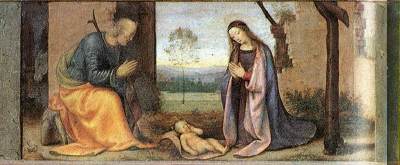
`Out of love for us, he took upon himself our human condition, our fragility, our vulnerability and he opened up for us the path that leads to the fullness of life to a share in the life of God himself.
As we ponder this great mystery in our hearts this Christmas, let us give thanks to God for his goodness to us and let us joyfully proclaim to those around us the good news that God offers us freedom from whatever weighs us down: he gives us hope, he brings us life.`
Pope Benedict XVI on Thought for the Day 24.12.10
Wednesday, December 21, 2011
Christmas Masses
The phone never stops at this time of year with people asking what time the Christmas Masses are so here they are!
Christmas Mass Times:
St Mary`s, Forest Hall: Christmas Eve 5.30 and Midnight (Missa Cantata, Extraordinary Form) ( carols before both) and Christmas Day 10.30am.
SS Peter and Paul`s, Longbenton Christmas Eve 7.30pm and Christmas Day 9.15am
I have been fortunate in being able to celebrate a sung Midnight Mass in the Extraordinary Form since every year since 1997. I`m glad we once again have the musicians and servers available to make it possible.
UPDATE 24.12.11 ok so it didn`t make much difference. The phone is ringing every five minutes. I have left a message on the answerphone with Mass times but the last caller rang three times so i answered. Some callers refuse to believe me when I tell them the Mass times!
Cathedral Sermon
I have been meaning to put my sermon from the EF Mass at the cathedral, held on November 5th on the log for a while. It`s not really very festive but I`d better not leave it any longer. I`ve tried to tidy up my notes into real English but there may still be parts I`ve missed.
Many thanks to first of all to the cathedral dean, Fr Leighton for his permission for this Mass today. Thanks to singers and servers. Mass celebrated under the legislation Summorum Pontificum and Universae Ecclesiae. Please note the word universae: this is for the whole CHurch and not just a small group of disaffected Catholics who struggle with `the changes`. These have been major initiatives of our Holy Father who wants the Church to rediscover the beauty of her traditional worship. In many places in the world Catholics are becoming familiar again with these ancients forms of worship which sustained the church for so many centuries and which were the inspiration of the lives of so many saints.
Yet in quite a lot of the Catholic world Summorum Pontificum remains a bit of a dead letter with little provision being made on a diocesan level. In some places you can read the diocesan newspaper and never know that SP exists and what does happen remains the initiative of individual priests who never receive any encouragement from their diocesan superiors. Yet time is surely on the side of Summorum Pontificum. Universae Ecclesiae says:
Ordinaries are asked to offer their clergy the possibility of acquiring adequate preparation for celebrations in the forma extraordinaria. This applies also to Seminaries, where future priests should be given proper formation, including study of Latin and, where pastoral needs suggest it, the opportunity to learn the forma extraordinaria of the Roman Rite.
Ridiculous that men should spend 6 years in seminary and only learn half of the Roman Rite. Are there not more important things? Not really. It is the Mass that matters and a priest`s whole life is bound up with knowing and loving the Mass so it is important that he is well-grounded in its tradition. One day….
You may not have heard of it before of today`s feast. Nov 5th? Isn`t that Guy Fawkes night? Well in England & Wales, in the Extraordinary Form, in many dioceses it is Feast of Holy Relics of the diocese. What are they? If bishop Ambrose`s projection is correct then by 2028 all we will have is a few holy relics of the diocese! No, the idea is that all the relics of the saints kept in the diocese are honoured this day. Relics of saints? You mean bits of bones and things?
Subject can`t be raised nowadays especially among many Catholics without a shaking of the head and then stories of how there are three heads of St John the Baptist and enough fragments of the true cross to build a battleship and what about the empty bottle claming to contain the breath of the Holy Spirit or the feather that is meant to be from the wing of the angel Gabriel? Isn`t it all just fraudulent nonsense and nothing to do with our living the faith (same people often say same thing about Summorum Pontificum).
Yet if we look at Christian and especially our Catholic history we can see it was not always so. To an outside observer in the early church it often seemed that Christians were people whose only interest was bones. Julian the Apostate `You have filled the whole world with tombs and sepulchres`
The Romans like many Mediterranean societies, regarded the bodies of the dead as polluting. During Rome's classical period, the body was most often cremated, and the ashes placed in a tomb outside the city walls. Much of the month of February was devoted to purifications, propitiation, and veneration of the dead, especially at the nine-day festival of the Parentilia during which a family honoured its ancestors. The family visited the cemetery and shared cake and wine, both in the form of offerings to the dead and as a meal among themselves.
4th century pagan writer Eunapius:
For they collected the bones and skulls of criminals who had been put to death for numerous crimes…. Made them out to be gods and thought that they became better by defiling themselves at their graves. `Martyrs` the dead men were called and ministers of a sort and ambassadors with the gods to carry men`s prayers`
Christians changed the landscape with their feasting at tombs of martyrs. Shrines were constructed which became large churches and to keep on top of things bishops moved to live there. The most famous example is the Vatican: a cemetery where Peter was buried and now the centre of the Catholic world.
Julian pointed out that none of this is mentioned in Gospels. But tombs of prophets were holy places in Judaism and reflected belief in the resurrection of the dead. The martyr`s body remained on earth awaiting the last day when it would be reunited with his or her soul. A place of the presence of the saint and of his or her power. Saints work miracles at their tombs and mirackes are still a requirement for canonisation.
But isn`t this all vulgar superstition? Surely this was for the uneducated masses and the serious Christian theologians had none of it. Not so. One of the books that had a major influence on me was Peter Brown`s Cult of the Saints published in 1981. He shows how the cult of the saints permeated all levels of the church. For example Augustine`s great work The City of God explained how God had not abandoned his people after the sack of Rome in 410 and yet the last book was a long catalogue of the miracles worked at he shrines of St Stephen at Hippo and Uzalis.
Some see this as the decline of the times. AHM Jones in later Roman Empire `a sign of the times that man of the intellectual eminence of Augustine should attach importance to them`
Not just Augustine. Ambrose in 385 discovery of the relics of SS Gervasius and Protasius. Huge excitement an placed in Ambrose`s new basilica under the altar where his own tomb was to be.
And so on. Body of Cuthbert carried around. Durham cathedral built as shrine which became a magnet for pilgrims.
As Christians we say we believe in resurrection of the body. Our bodies are ours forever whatever their final destination. We achieve holiness or we reject God in the body. Our bodies have an eternal significance. The bodies of the canonised saint is a window into heaven. St Therese on tour in his country drew large crowds. Bishop of Shrewsbury has just announced that the heart of the Cure of Ars will be on loan to his diocese soon. Here is something that will live forever in God`s presence. As Catholics the relics of the saints are a pledge of eternal glory. Today we honour their presence in the diocese as pledges of eternal life and so feel closer to the things of heaven and the life of God`s saints
More on silence
Since my last few posts I have had an email from Nancy Parker who recommends this link on why silence is good for children. You can find it here.
Monday, December 19, 2011
Thanks for the comments
I`ve decided to re-instate the ringing of a bell five minutes before the start of Mass again to indicate the start of silent preparation for Mass. I suppose we can`t do anything about the end of Mass. We used to ring this bell but sometimes people thought it was the bell for the start of Mass and even the hymns would start on occasion. It is so hard to try to make a difference in a parish and this isn`t about Latin or ad orientem but simply giving space to let people pray before and after Mass.
Sunday, December 18, 2011
I read the pastoral letter on silence and .......
talking continued at full throttle in church as usual after Mass. I might as well have just done some juggling or stood on my head.
Saturday, December 17, 2011
This weekend we will have a pastoral letter
The bishop of Aberdeeen`s Advent pastoral letter has already been mentioned on the blogosphere. If you`ve not read it I reproduce it below. I liked it so much that I have decided to read it out at Mass this weekend instead of a sermon. Thank God for bishop Hugh Gilbert!
Dear Brothers and Sisters,
We live in a noisy world. Our towns and cities are full of noise. There is noise in the skies and on the roads. There is noise in our homes, and even in our churches. And most of all there is noise in our minds and hearts.
The Danish philosopher Kierkegaard once wrote: ‘The present state of the world and the whole of life is diseased. If I were a doctor and I were asked for my advice, I should reply: “Create silence! Bring people to silence!” The Word of God cannot be heard in the noisy world of today. And even if it were trumpeted forth with all the panoply of noise so that it could be heard in the midst of all the other noise, then it would no longer be the Word of God. Therefore, create silence!’
‘Create silence!’ There’s a challenge here. Surely speaking is a good and healthy thing? Yes indeed. Surely there are bad kinds of silence? Yes again. But still Kierkegaard is on to something.
There is a simple truth at stake. There can be no real relationship with God, there can be no real meeting with God, without silence. Silence prepares for that meeting and silence follows it. An early Christian wrote, ‘To someone who has experienced Christ himself, silence is more precious than anything else.’ For us God has the first word, and our silence opens our hearts to hear him. Only then will our own words really be words, echoes of God’s, and not just more litter on the rubbish dump of noise.
‘How silently, how silently, the wondrous gift is given.’ So the carol goes. For all the noise, rush and rowdiness of contemporary Christmasses, we all know there is a link between Advent and silence, Christmas and silence. Our cribs are silent places. Who can imagine Mary as a noisy person? In the Gospels, St Joseph never says a word; he simply obeys the words brought him by angels. And when John the Baptist later comes out with words of fire, it is after years of silence in the desert. Add to this the silence of our long northern nights, and the silence that follows the snow. Isn’t all this asking us to still ourselves?
A passage from the Old Testament Book of Wisdom describes the night of Israel’s Exodus from Egypt as a night full of silence. It is used by the liturgy of the night of Jesus’ birth:
‘When a deep silence covered all things and night was in the middle of its course, your all-powerful Word, O Lord, leapt from heaven’s royal throne’ (Wis 18:14-15).
‘Holy night, silent night!’ So we sing. The outward silence of Christmas night invites us to make silence within us. Then the Word can leap into us as well, as a wise man wrote: ‘If deep silence has a hold on what is inside us, then into us too the all-powerful Word will slip quietly from the Father’s throne.’
This is the Word who proceeds from the silence of the Father. He became an infant, and ‘infant’ means literally ‘one who doesn’t speak.’ The child Jesus would have cried – for air and drink and food – but he didn’t speak. ‘Let him who has ears to hear, hear what this loving and mysterious silence of the eternal Word says to us.’ We need to listen to this quietness of Jesus, and allow it to make its home in our minds and hearts.
‘Create silence!’ How much we need this! The world needs places, oases, sanctuaries, of silence.
And here comes a difficult question: what has happened to silence in our churches? Many people ask this. When the late Canon Duncan Stone, as a young priest in the 1940s, visited a parish in the Highlands, he was struck to often find thirty or forty people kneeling there in silent prayer. Now often there is talking up to the very beginning of Mass, and it starts again immediately afterwards. But what is a church for, and why do we go there? We go to meet the Lord and the Lord comes to meet us. ‘The Lord is in his holy temple. Let all the earth keep silence before him!’ said the prophet Habakkuk. Surely the silent sacramental presence of the Lord in the tabernacle should lead us to silence? We need to focus ourselves and put aside distractions before the Mass begins. We want to prepare to hear the word of the Lord in the readings and homily. Surely we need a quiet mind to connect to the great Eucharistic Prayer? And when we receive Holy Communion, surely we want to listen to what the Lord God has to say, ‘the voice that speaks of peace’? Being together in this way can make us one – the Body of Christ – quite as effectively as words.
A wise elderly priest of the diocese said recently, ‘Two people talking stop forty people praying.’
‘Create silence!’ I don’t want to be misunderstood. We all understand about babies. Nor are we meant to come and go from church as cold isolated individuals, uninterested in one another. We want our parishes to be warm and welcoming places. We want to meet and greet and speak with one another. There are arrangements to be made, items of news to be shared, messages to be passed. A good word is above the best gift, says the Bible. But it is a question of where and when. Better in the porch than at the back of the church. Better after the Mass in a hall or a room. There is a time and place for speaking and a time and place for silence. In the church itself, so far as possible, silence should prevail. It should be the norm before and after Mass, and at other times as well. When there is a real need to say something, let it be done as quietly as can be. At the very least, such silence is a courtesy towards those who want to pray. It signals our reverence for the Blessed Sacrament. It respects the longing of the Holy Spirit to prepare us to celebrate the sacred mysteries. And then the Mass, with its words and music and movement and its own moments of silence, will become more real. It will unite us at a deeper level, and those who visit our churches will sense the Holy One amongst us.
‘Create silence!’ It is an imperative. May the Word coming forth from silence find our silence waiting for him like a crib! ‘The devil’, said St Ambrose, ‘loves noise; Christ looks for silence.’
Yours sincerely in Him,
+ Hugh, O. S. B.
Bishop of Aberdeen
7 December 2011
Sunday, December 04, 2011
Priest, Pastor and Leader?
Last week at a funeral reception I got talking to two rather agitated laymen. They wanted to tell me about what was happening in their parishes. They both had the same complaint. A new parish priest had come in and, they said, closed down everything. Parish councils had been dismissed and many other committees. Not even social events were allowed any more. I found it hard to believe a parish priest would not want parishioners to enjoy social activities. For my part, I have always had a parish council as I find it on the whole a useful sounding board for ideas. I, of course, said that a parish council is optional unless the bishop, having listened to his Council of Priests, considers it opportune to mandate their creation in every parish which to my knowledge, has not happened in this diocese. I also pointed out that a Parish Council is essentially consultative and that while it may offer advice a parish priest is not bound to follow it although one would hope he would be able to give good reasons for not doing so.
However this did little to calm the rage. They had heard of a parish where the new parish priest on his first Sunday had told the congregation that he was in charge and he made the decisions so as to get things clear from the start. They said the Church needs to be brought up to date and that it is still in the nineteenth century. I`d never thought of the modern day Church as having anything remotely nineteenth century about it! I did mention Vatican Two and that bishops seem very keen nowadays to involve the laity at all levels of church life and how at priests` meetings the answer to problems always seems to be to hand things over to the laity. However this did nothing to restore peace. `Why do priests insist on looking after the finances when there are laity in a parish who have professional experience which the clergy lack?` So too with looking after buildings and grounds. Priests should hand all that over to the laity and thus be able to concentrate on being a spiritual leader. I have never looked after the parish book keep keeping so I don`t know if that wins me any gold stars.
While I can appreciate the point of this sometimes it is not unusual to find laity who think they should be allowed to preach as well. No doubt they would also want a liturgy commitee to oversee every aspect of worship. At this point it seems to me, as I mentioned to a senior cleric recently, the only job left for the priest to do is to be the caretaker, making sure the doors are open, unless of course, as often happens, they have keys to the building already.
Of course there are documents. There was the 1997 document, Ecclesiae de mysterio, a rare collaboration between eight Vatican dicasteries, which said that lay people should not have the title chaplain amongst other things. Also relevant is the Congregation for Clergy`s document `The Priest, Pastor and Leader of the Parish Community` which talks among other things about parish councils and erroneous thinking about them. I think it fair to say I never hear these documents referred to much in local discussions on the matter of the role of the laity. My laymen complained that decisions were made by a lot of old men in Rome and therefore were, I presume, self-evidently ridiculous.
However the issue is important as priests are unsure what they are meant to be doing. A priest may feel he is doing the right thing if he hands over the running of his parish to committees of parishioners who then give the pastoral lead. On the other hand a priest is a pastor with a role of guiding the flock and as such has the duty to mould his parish life according to the mind of the Church and have the resources to achieve this. While seeking to avoid a stifling clericalism, which treats the laity like children and which even clergy of a `progressive ` bent can fall into, it seems we have a new problem these days in a certain type of laity who can regard the very existence of the priest as an affront to their participation in the life of the Church.
Subscribe to:
Posts (Atom)