On the CNS there is a statement by the Vatican press officer, Fr Lombardi, which denies yesterday`s story about the Pope using the 1962 missal. Here it is:
Vatican spokesman: Pope concelebrates daily Mass using current missal
By Cindy Wooden
Catholic News Service
VATICAN CITY (CNS) -- Pope Benedict XVI concelebrates his daily morning Mass in Italian using the current edition of the Roman Missal, the Vatican spokesman said.
Claims that the pope celebrates his private Mass using the Tridentine rite are incorrect, Jesuit Father Federico Lombardi told Catholic News Service July 17.
The Tridentine Mass is the Latin-language liturgy that predates the Second Vatican Council; it was last revised in the 1962 edition of the Roman Missal.
Less than 10 days after Pope Benedict July 7 issued his letter and norms providing greater opportunity for the celebration of the Tridentine Mass, news reports claimed Pope Benedict already had been celebrating the old rite privately.
"The confusion probably was caused by our footage of the pope celebrating facing the altar, which is due to the fact that the altar is against the wall" in the private chapel of the Apostolic Palace, Father Lombardi said.
With the altar against the wall, the concelebrants in the private chapel end up having their backs toward the congregation during the eucharistic prayer. The congregation at the morning Mass generally is made up of the pope's valet and the consecrated women who staff the papal apartment.
The images Father Lombardi referred to were released by the Vatican to coincide with celebrations of Pope Benedict's 80th birthday April 16. Father Lombardi heads the Vatican Television Center, which produced the footage, as well as serving as director of the Vatican press office and Vatican Radio.
Father Lombardi also said the fact that the pope's two private secretaries concelebrate the Mass with him each morning "obviously means he is using the new Missal," since the Tridentine Mass strictly limits concelebration.
At public Masses with an international congregation, Pope Benedict uses the post-Vatican II Mass with most of the prayers in Latin. However, on occasions such as the feast of the Body and Blood of Christ, which is considered a Rome diocesan celebration although there is an international congregation, the pope recites the prayers in Italian.
Tuesday, July 17, 2007

Monday, July 16, 2007
Pope Benedict leads the way
This story is on CWNews today. It is not true to say that Pope John Paul II celebrated his private Mass facing the people. I went twice and it was celebrated `ad orientem` and the altar was attached to the wall. I hope the rest of the story is reliable. I had wondered if this might be the reason that there was now no access to the Pope`s early morning Mass.
Pope Benedict uses older ritual for his private Mass
Pope Benedict uses older ritual for his private Mass
Vatican, Jul. 16, 2007 (CWNews.com) - Pope Benedict XVI (bio - news), who recently issued a motu proprio allowing all Catholic priests to celebrate the old Latin Mass, uses the older ritual himself for his private Mass, CWN has learned. Informed sources at the Vatican have confirmed reports that the Holy Father regularly celebrates Mass using the 1962 Roman Missal. In his motu proprio Summorum Pontificum the Pope says that the older form-- the form in universal use before the liturgical changes that followed Vatican II-- was never abrogated. Since becoming Roman Pontiff, Benedict XVI has always used the new ritual-- which he identifies in Summorum Pontificum as the "ordinary form" of the Roman rite-- for public celebrations of the Eucharistic liturgy. However few people have witnessed the Pope celebrating his private daily Mass. Unlike his predecessor John Paul II, who regularly invited visitors to attend the Mass that he celebrated each morning in his private chapel, Benedict XVI has made it his regular practice to celebrate Mass with only a few aides. The Pope's closest associates have established a reputation for preserving confidences. Shortly after his election in April 2005, Pope Benedict ordered renovations of the Redemptoris Mater chapel in the apostolic palace. The changes included replacing the free-standing altar at which Pope John Paul celebrated Mass facing the congregation with a longer altar, closer to the rear wall of the chapel and with a tabernacle in the center. The new arrangement allows for the Pope to celebrate Mass in the ad orientem posture required for the older ritual. Pope Benedict has long been known as an ardent defender of the Catholic liturgical tradition. In the early 1990s he raised eyebrows in Rome by writing a laudatory preface to the book The Reform of the Roman Liturgy, in which Msgr. Klaus Gamber decried many of the liturgical changes of the past few decades. Then-Cardinal Ratzinger also traveled to Wigratzbad, in Bavaria, to ordain priests for the Fraternity of St. Peter, a group devoted to the use of the traditional liturgy. He performed those ordinations, as well as Mass on Easter Sunday in 1990, using the 1962 Roman Missal.
UPDATE. 17.07.07 CWNews has removed the part about John Paul II and has added this note:
Editor's note Several CWN readers have pointed out that Pope John Paul II could and did celebrate Mass ad orientem in the papal chapel before the renovations that Benedict XVI commissioned. Because the paragraph on the renovations was confused, and added nothing to the substance of this story, we have removed it from this report.
Sunday, July 15, 2007
This cheered me up this morning
 From the Pittsburgh Post Gazette
Demand may rise with Pope's approval of Latin Mass
Some view traditional liturgy as divisive, others attracted by reverence
Sunday, July 15, 2007
By Ann Rodgers, Pittsburgh Post-Gazette
At 11 a.m. today, Latin chant will fill St. Boniface Church, as veiled young women kneel with their husbands and children to hear the Rev. Matthew Talarico offer his first High Mass for Pittsburgh Latin Mass Community.
The 26-year-old from Cecil was ordained last month by Archbishop Raymond Burke of St. Louis for a community whose call is to offer the traditional Latin, or Tridentine, Mass. Demand is expected to rise now that Pope Benedict XVI has said that the 1962 Mass -- the last approved Latin Mass before the changes of Vatican II -- no longer requires special permission from the bishop.
"Latin is the mother tongue of all Catholics," said Father Talarico, who will serve in the Archdiocese of Newark, N.J.
"Modern languages are always changing. In order to express a timeless liturgy and eternal truths, we use a language with a venerable tradition, a language which does not change, a language which unites us with all of our ancestors in the faith and which serves as a bridge to the future in bringing all Catholics the unity of faith."
But use of the Tridentine Mass is controversial. Some bishops had not permitted it, in part because they believed it spawned division and elitism. Some Catholics associate it with schismatic movements that reject all teachings of Vatican II. Jewish leaders expressed concerns because the 1962 Good Friday liturgy includes a prayer for the conversion of Jews.
Father Talarico, however, was trained in Italy for the Institute of Christ the King, which is approved by the Vatican. He accepts Vatican II, noting that it hails Latin as the official language of the church.
The Pittsburgh Latin Mass Community, established in 1989, meets in St. Boniface Church of Holy Wisdom parish in the North Side. The Rev. Lawrence DiNardo, pastor of Holy Wisdom and chief canon lawyer for the diocese, will help decide how to apply the new rules.
Although he is not its chaplain -- the Rev. Kenneth Myers is -- the Latin Mass Community has been an asset to his parish, he said. With 650 participants, it is one of the largest diocesan Tridentine communities in the U.S.
Neither Father DiNardo, nor the Rev. Ronald Lengwin, the diocesan spokesman, expect the pope's decree to change much here. It doesn't require every pastor to offer the Mass if requested, Father DiNardo said. Those who want 1962 liturgy will continue to go to St. Boniface, he said.
However, the diocese is currently more permissive than the pope. Two Sunday Masses are held here; the pope permitted just one. Pittsburgh has had permission for all Holy Week services; the pope forbade the Tridentine celebration of Holy Thursday, Good Friday and Holy Saturday.
"We can't say yet whether any of that will be grandfathered in," Father Lengwin said.
Some of the greatest concerns about the 1962 Mass concern Good Friday. Catholics and Jews involved in theological dialogue have objected to a Good Friday prayer for the conversion of Jews. It replaced a more infamous Good Friday prayer for "perfidious Jews," which Pope John XXIII excised in 1959.
The 1962 prayer is offered "for the blindness of that people so that they may acknowledge the light of your truth, which is Christ, and be delivered from their darkness."
Last week the International Jewish Committee on Interreligious Consultations sent an urgent letter to the Vatican, asking for assurance that the 1962 Good Friday liturgy was banned.
Rabbi Alvin Berkun, of Pittsburgh, is president of the international organization for Conservative rabbis and a participant in dialogues with the Vatican. Although he wants the Good Friday prayer removed, he discounted the fears of some rabbis that wider approval of the old Mass means a return to an old theology that cast Jews as "Christ-killers."
"As a rabbi, I wouldn't want the church telling me how much Hebrew I can put in my service. I don't think rabbis should be telling them how much Latin to use. I don't read into it any negative or nefarious suppositions," he said.
The Rev. Jerome Vereb, a Pittsburgher who once worked in the Vatican office that oversees relations with other Christians and Jews, said that those who attend diocesan-sponsored Latin Masses don't share the anti-ecumenical, anti-Jewish views of some schismatic groups.
He has occasionally attended a Latin Mass in New York City.
"The church is full of young people and people from other countries," he said.
"You see everyone from the Japanese ambassador to the United Nations to a Haitian lady who works as a nanny going to the Latin Mass. They go because there is still a universal quality and a sense of history to it."
Father Talarico first attended Latin Mass at 13. He had already sensed a call to priesthood.
The Latin Mass "was mysterious, but very attractive," he said. "There was a real sense of reverence. I wanted to learn more, and became an altar boy."
Yesterday he celebrated low Mass -- without chant, or the Bible readings and sermon that would otherwise be in English. Vested in a lace alb and ornate chasuble, he prayed facing the same direction as the people, so they saw only his back.
The 50 worshipers could follow in a Latin-English missal, which explained every gesture. But they never spoke. Only the altar boys -- they have no altar girls -- answered in Latin.Jim Cardelini, 41, of Munhall, has attended for about five years.
"At first we came because of an invitation. But then we started to come more. My wife and I were attracted by the reverence," he said.
"In the silence and the meditation, there is a mystical experience."
Lack of speech doesn't mean lack of participation, Father Talarico said.
"Participation is interior. It comes from the heart," he said. "People love that beauty. They can pray very simply to God."
In a letter accompanying his decree, the pope sought to allay the fears of some bishops that the Mass would be divisive. He expected it to have limited appeal.
"The use of the old missal presupposes a certain degree of liturgical formation and some knowledge of the Latin language; neither of these is found very often," he wrote.
But, he wrote, some people were deeply hurt by the sudden revolution in their worship. He didn't name the followers of the late Archbishop Marcel Lefebvre, who rejected Vatican II. But, as the former Cardinal Joseph Ratzinger, he had attempted to reconcile the Lefebvrists. The new decree is not expected to heal the schism. Lefebvrist leaders have said they cannot accept current church teaching on many issues.
Nevertheless, the pope was thinking of reconciliation.
"Looking back over the past, to the divisions which in the course of the centuries have rent the Body of Christ, one continually has the impression that, at critical moments when divisions were coming about, not enough was done by the Church's leaders to maintain or regain reconciliation and unity," he wrote.
Father Talarico joined the Institute of Christ the King because it is not divisive, he said. Its priests serve at the request of bishops, who often lack priests able to offer the Latin Mass.
"Our mission is to teach the truth of the Catholic Church, but to teach it with charity. We want to show that the faith is attractive for people today, that it has answers for all of the problems of today's world. But ultimately, it is about love," he said.
"We are not about going back to something, we are looking ahead to the future. The Mass is timeless. The church is always young.
Friday, July 13, 2007
The Tablet
An apology to eccentrics. In my comments to the Tablet I say that the Tridentine Mass now belongs to the mainstream of Catholic life. It quotes me as saying: "This is not something for the eccentrics". I wouldn`t want it thought that I am excluding eccentrics from the benefits of Summorum Pontificum. What I probably meant to say was something like the 1962 missal is not just for eccentrics. If you are eccentric and thinking of coming to the Latin Mass but are worried you might get a frosty reception please be assured that this will not be the case.
That Catholic Show - You Are A Priest Forever
Hat tip to the Curt Jester for this. I`d not heard of That Catholic Show before
Wednesday, July 11, 2007
Leading the way
Good to see a bishop who previously has refused to authorise the use of the 1962 missal in his diocese now, in the light of Summorum Pontificum saying that he will take it upon himself to celebrate the extraordinary form himself!
From the American National Catholic Register.
“I am the only bishop in Wisconsin who does not now give permission for the Mass of Blessed John XXIII, as I did not feel the adequate catechesis was in place,” Bishop Robert Morlino of Madison told the Register. “But now that the Holy Father has indicated his desire for this extraordinary form to be more widely used, not only will the decree be implemented, but I intend to take the lead. I hope myself to celebrate this Mass, through which I found my own vocation.”
Press Office of the Holy See
This useful reflection by the Press Office of the Holy See appears on the blog of Fr John Boyle, the South Ashford priest. I include it here for those who may not have seen it.
1. The Motu Proprio 'Summorum Pontificum' lays down new rules for the use of the Roman liturgy that preceded the reform of 1970. The reasons for such provisions are clearly explained in the Holy Father's letter to bishops which accompanies the Motu Proprio (the two documents have been sent to all the presidents of Episcopal conferences and to all nuncios, who have arranged to distribute them to all bishops).
2. The fundamental provision is as follows: the Roman liturgy will have two forms ('usus'):
a) The ordinary form is the one that follows the liturgical reform undertaken by Pope Paul VI in the year 1970, as it appears in the liturgical books promulgated at that time. There is an official edition in Latin which may be used always and everywhere, and translations in divers languages published by the various Episcopal Conferences.
b) The extraordinary form: which is that celebrated in accordance with the liturgical books published by Blessed Pope John XXIII in 1962."
3. The Motu proprio allows the use of the prior liturgy for those who desire it; it does not intend, on the other hand, to impose the extraordinary form, that is, the prior liturgy, on those who are happy with the ordinary form.
4. The liturgy according to the 1962 books is celebrated in the Latin language but the readings contained in the Missal can be read to the people in the vernacular. To favor an active participation, the faithful who attend such celebrations are invited to recite together with the celebrant the diverse parts of the ‘Ordinarium Missae’ (Ordinary of the Mass – Kyrie, Gloria, Credo, Sanctus, Agnus Dei) which, in sung Masses, may be sung and if possible even by the people. When there are faithful present, it is not suitable for the entire Mass to be celebrated in a low voice. It is recommended that the faithful follow the prayers of the Mass with a bi-lingual missal, such as those that already exist and which will certainly be re-edited.
5. In parishes, in practice, the liturgy being used will not change: instead, it will be possible for the pastor to add to the Masses celebrated in the ordinary form, a second Mass according to the extraordinary form.
6. The two forms of the liturgy follow two diverse calendars, different on the dates of several secondary feasts, and they have two diverse lectionaries. Such differences should not create great difficulties: for example, the Ambrosian rite, celebrated in the Diocese of Milan, has its own calendar and lectionary.
7. The Motu proprio foresees the possibility of using the earlier rite for the Sacraments of Baptism and Matrimony. If such a reasonably-motivated demand exists, the pastor can decide to use the earlier missal; it is clear, however, that all prescriptions on the preparations for these sacraments, that have been set forth by the Episcopal Conferences, remain in force. The same possibility exists for funerals, both for the funeral Mass in church and for the funeral rite at the cemetery.
8. The local bishop may erect a personal parish, when in that place is found a very substantial number of faithful who wish to follow the earlier liturgy. It would be appropriate for the numbers of faithful to be substantial, even if not comparable to those of other parishes.
9. The liturgical books needed for the extraordinary form of the Roman liturgy are:- The Roman Missal in the 1962 edition; previous editions differ in the rubrics on the status (level) of feasts. In the 1962 edition there is always the ‘Ordo Hebdomadae Sanctae,’ previously renewed in 1955 by Pope Pius XII. Pope John XXIII reformulated the prayer ‘Pro Judaeis’ in the Good Friday liturgy, and inserted it in this edition of the Roman Missal. Thus, it is not licit to use the Holy Week liturgy prior to the 1962 edition.
- The Roman Ritual, for the Sacraments of Baptism, Matrimony, Penance, Anointing of the Sick and other Blessings and Prayers contained in the Ritual.
- The Roman Pontifical for the case in which the bishop decides to confer Confirmation on a group of faithful who wish it in the earlier rite. The use of the 1962 Roman Pontifical was permitted in 1988 for those communities who followed the entire earlier rite of conferring the Sacrament of Orders.
- The Roman Breviary, for priests who wish to recite the Divine Office in consonance with the 1962 Missal.All four of these liturgical books must be reprinted for practical use. Those publishing houses that specialize in such books must be charged with this, with the ‘recognitio’ of the competent Pontifical Commission.
10. The priests necessary for the celebration of the liturgy in the extraordinary form must be prepared for this task.
11. The Motu proprio foresees that the jurisdiction for the application of the new dispositions belongs to the “Ecclesia Dei” Pontifical Commission which will take care of problems that could arise.
12. The Motu proprio is scheduled to enter into force on September 14. The Pope’s Letter explicitly asks Bishops to give an accounting after three years, in such a way as to be able to find solutions if “serious difficulties” arise.
The explanatory note also highlights several characteristics of the 1962 Missal:"It is a 'plenary' or 'integral' Missal in the Latin language, that is, it also contains the readings for the celebrations (it is not distinct from the 'Lectionary' as the later 1970 Missal is)."
It contains just one Eucharistic prayer, the 'Roman Canon' (corresponding to the first Eucharist Prayer of the later Missal, which includes a choice of various Eucharistic Prayers)."
Various prayers (including a large part of the Canon) are recited by the priest in a low voice inaudible to the people."
Other differences include the reading of the beginning of the Gospel of John at the end of Mass.
"The 1962 Missal does not provide for concelebration. It says nothing concerning the direction of the altar or of the celebrant (whether facing the people or not).
"The Pope's Letter envisages the possibility of future enrichment of the 1962 Missal (inclusion of new saints, new prefaces, etc.)."
[Translation of Italian original by Joan Lewis, EWTNews]
Helpful
These comments from Cardinal Ricard are useful as too often in the past despite the text of Ecclesia Dei saying its provisions were for all those attached to the traditional liturgy, we were told that those provisions were intended to draw back followers of Archbishop Lefebvre. Now it is clear you don`t have to have been one of his followers to benefit from the Motu Proprio but they are for any Catholic who is interested. From CNA today:
Motu Proprio is meant for those faithful to Vatican II and will change nothing for most Catholics, says Cardinal Ricard
Rome, Jul 11, 2007 / 10:37 am (CNA).- Cardinal Jean Pierre Ricard, president of the Bishops’ Conference of France, said this week the Motu Proprio Summorum Pontificum by Pope Benedict XVI “is intended for Catholics faithful to the Pope and respectful of the authority of the Council (Vatican II) and who desire to use the 1962 Missal.”
In noting that “the ancient liturgy has nourished the faith of the faithful during centuries and can still do so today,” Cardinal Ricard said Vatican II was not a “break” but rather a continuation of the tradition of the Church. He stressed that by issuing the document, Pope Benedict is calling on “the council faithful and the traditionalists to begin a journey towards reconciliation and communion.”
The Pope greatly desires “the unity of Catholics, he wants to favor reconciliation and reconcile the Church with her liturgical past. It’s also a gesture towards the followers of Archbishop Lefebvre, but the Pope knows that in this case the differences are not only liturgical,” the cardinal said.
He emphasized that the “Missal of 1970 remains the ordinary form of celebration. This is not bi-ritualism but rather one rite that can be celebrated in two ways. For most Catholics nothing will change,” the cardinal stated.
Tuesday, July 10, 2007
Tagged
I`ve been tagged by Fr John Boyle of the South Ashford Priest blog. The questions are:
1. How did you start blogging?
I wanted to post a comment on another blog and found that to do so I needed to set up my own.
2.What do you hope to achieve or accomplish with your blog? Have you been successful?
I hoped to find a sympathetic audience for some of my recent difficulties and to communicate with other enthusiasts for the Extraordinary Form of the Roman Rite. I would say that in this it has been successful.
3. Has the focus of your blog changed since you started blogging? How?
Not as yet.
4. What do you know now that you wish you'd known when you started?
Nothing comes to mind.
5. Does your immediate or extended family know about your blog? If so, do they read it? If not, why?
My brothers read my blog.
6. What advice would give to a new blogger?
I`ve not really had much trouble with hostile posts as yet. It is important to remember that absolutely anyone can read your blog and to think before posting about how what you write will be taken.
I tag Vocation: thoughts of a teenage Christian.
Sunday, July 08, 2007
St Joseph`s Gateshead

After the excitement of yesterday, I was glad to be able to celebrate the extraordinary form of the Roman rite at St Joseph`s, Gateshead today at noon. I was called by the parish priest on Friday and asked to be the celebrant for Sunday. I was glad that I was able to do so. At my two previous Masses at St Aidan`s Benton and St Mary`s here, I spoke about the Motu Proprio, summarised the explanatory letter and mentioned some of the legal points. At St Joseph`s it was good to be able to celebrate the news with a congregation of about 60. At the end of the Mass, the schola led us in singing the Te Deum. Here are some pictures. ( I don`t know why the white altar frontal was being used on a green Sunday. There is another all purpose one which is normally used.)


Abortion: Cardinal throws down gauntlet to PM
My attention has been drawn to this article from the Scotsman. Cardinal O`Brien continues to speak out.
Saturday, July 07, 2007
Reaction
The website of the bishops of the USA has acknowledged the issue of the Motu Proprio today and has even provided a commentary courtesy of their liturgy committee. Nothing as yet from the bishops of England and Wales. The only diocese in England and Wales to have news about the Motu proprio on its website today is the diocese of Northampton and that was published on Friday. It will be interesting to see what Monday brings.
UPDATE 08.07.07. There is a response on the Westminster website.
UPDATE 08.07.07. There is a response on the Westminster website.
This morning

This Saturday began as usual with a 10am Mass in, what we must now call, the extraordinary form of the Roman rite.
After Mass we waited until 11 and then printed off the copies of the Motu Proprio from the web. Here you see some of the faithful taking it in.
Here I am cutting the cake.
GOD BLESS POPE BENEDICT THE GREAT!
APOSTOLIC LETTER
SUMMORUM PONTIFICUM
OF
THE SUPREME PONTIFF
BENEDICT XVI
GIVEN MOTU PROPRIO
[ONLY LEGAL ARTICLES OFFICIALLY TRANSLATED]
Our predecessor John Paul II having already considered the insistent petitions of these faithful, having listened to the views of the Cardinal Fathers of the Consistory of 22 March 2006, having reflected deeply upon all aspects of the question, invoked the Holy Spirit and trusting in the help of God, with these Apostolic Letters
We establish the following:
Art. 1 The Roman Missal promulgated by Paul VI is the ordinary expression of the Lex orandi (Law of prayer) of the Catholic Church of the Latin rite. Nonetheless, the Roman Missal promulgated by St. Pius V and reissued by Bl. John XXIII is to be considered as an extraordinary expression of that same Lex orandi, and must be given due honour for its venerable and ancient usage. These two expressions of the Church’s Lex orandi will in no any way lead to a division in the Church’s Lex credendi (Law of belief). They are, in fact two usages of the one Roman rite.It is, therefore, permissible to celebrate the Sacrifice of the Mass following the typical edition of the Roman Missal promulgated by Bl. John XXIII in 1962 and never abrogated, as an extraordinary form of the Liturgy of the Church. The conditions for the use of this Missal as laid down by earlier documents Quattuor abhinc annis and Ecclesia Dei, are substituted as follows:
Art. 2 In Masses celebrated without the people, each Catholic priest of the Latin rite, whether secular or regular, may use the Roman Missal published by Bl. Pope John XXIII in 1962, or the Roman Missal promulgated by Pope Paul VI in 1970, and may do so on any day with the exception of the Easter Triduum. For such celebrations, with either one Missal or the other, the priest has no need for permission from the Apostolic See or from his Ordinary.
Art. 3 Communities of Institutes of consecrated life and of Societies of apostolic life, of either pontifical or diocesan right, wishing to celebrate Mass in accordance with the edition of the Roman Missal promulgated in 1962, for conventual or “community” celebration in their oratories, may do so. If an individual community or an entire Institute or Society wishes to undertake such celebrations often, habitually or permanently, the decision must be taken by the Superiors Major, in accordance with the law and following their own specific decrees and statues.
Art. 4 Celebrations of Mass as mentioned above in art. 2 may – observing all the norms of law – also be attended by faithful who, of their own free will, ask to be admitted.
Art. 5 § 1 In parishes, where there is a stable group of faithful who adhere to the earlier liturgical tradition, the pastor should willingly accept their requests to celebrate the Mass according to the rite of the Roman Missal published in 1962, and ensure that the welfare of these faithful harmonises with the ordinary pastoral care of the parish, under the guidance of the bishop in accordance with canon 392, avoiding discord and favouring the unity of the whole Church.
§ 2 Celebration in accordance with the Missal of Bl. John XXIII may take place on working days; while on Sundays and feast days one such celebration may also be held.
§ 3 For faithful and priests who request it, the pastor should also allow celebrations in this extraordinary form for special circumstances such as marriages, funerals or occasional celebrations, e.g. pilgrimages.
§ 4 Priests who use the Missal of Bl. John XXIII must be qualified to do so and not juridically impeded.
§ 5 In churches that are not parish or conventual churches, it is the duty of the Rector of the church to grant the above permission.
Art. 6 In Masses celebrated in the presence of the people in accordance with the Missal of Bl. John XXIII, the readings may be given in the vernacular, using editions recognised by the Apostolic See.
Art. 7 If a group of lay faithful, as mentioned in art. 5 § 1, has not obtained satisfaction to their requests from the pastor, they should inform the diocesan bishop. The bishop is strongly requested to satisfy their wishes. If he cannot arrange for such celebration to take place, the matter should be referred to the Pontifical Commission “Ecclesia Dei”.
Art. 8 A bishop who, desirous of satisfying such requests, but who for various reasons is unable to do so, may refer the problem to the Commission “Ecclesia Dei” to obtain counsel and assistance.
Art. 9 § 1 The pastor, having attentively examined all aspects, may also grant permission to use the earlier ritual for the administration of the Sacraments of Baptism, Marriage, Penance, and the Anointing of the Sick, if the good of souls would seem to require it.§ 2 Ordinaries are given the right to celebrate the Sacrament of Confirmation using the earlier Roman Pontifical, if the good of souls would seem to require it.§ 2 Clerics ordained “in sacris constitutis” may use the Roman Breviary promulgated by Bl. John XXIII in 1962.
Art. 10 The ordinary of a particular place, if he feels it appropriate, may erect a personal parish in accordance with can. 518 for celebrations following the ancient form of the Roman rite, or appoint a chaplain, while observing all the norms of law.
Art. 11 The Pontifical Commission “Ecclesia Dei”, erected by John Paul II in 1988, continues to exercise its function. Said Commission will have the form, duties and norms that the Roman Pontiff wishes to assign it.
Art. 12 This Commission, apart from the powers it enjoys, will exercise the authority of the Holy See, supervising the observance and application of these dispositions.We order that everything We have established with these Apostolic Letters issued as Motu Proprio be considered as “established and decreed”, and to be observed from 14 September of this year, Feast of the Exaltation of the Cross, whatever there may be to the contrary.From Rome, at St. Peter’s, 7 July 2007, third year of Our Pontificate.
______________
Papal Explanatory Letterto the Apostolic Letter
SUMMORUM PONTIFICUM
My dear Brother Bishops,With great trust and hope, I am consigning to you as Pastors the text of a new Apostolic Letter "Motu Proprio data" on the use of the Roman liturgy prior to the reform of 1970. The document is the fruit of much reflection, numerous consultations and prayer.News reports and judgments made without sufficient information have created no little confusion. There have been very divergent reactions ranging from joyful acceptance to harsh opposition, about a plan whose contents were in reality unknown.
This document was most directly opposed on account of two fears, which I would like to address somewhat more closely in this letter. In the first place, there is the fear that the document detracts from the authority of the Second Vatican Council, one of whose essential decisions – the liturgical reform – is being called into question. This fear is unfounded. In this regard, it must first be said that the Missal published by Paul VI and then republished in two subsequent editions by John Paul II, obviously is and continues to be the normal Form – the Forma ordinaria – of the Eucharistic Liturgy. The last version of the Missale Romanum prior to the Council, which was published with the authority of Pope John XXIII in 1962 and used during the Council, will now be able to be used as a Forma extraordinaria of the liturgical celebration. It is not appropriate to speak of these two versions of the Roman Missal as if they were "two Rites". Rather, it is a matter of a twofold use of one and the same rite.As for the use of the 1962 Missal as a Forma extraordinaria of the liturgy of the Mass, I would like to draw attention to the fact that this Missal was never juridically abrogated and, consequently, in principle, was always permitted. At the time of the introduction of the new Missal, it did not seem necessary to issue specific norms for the possible use of the earlier Missal. Probably it was thought that it would be a matter of a few individual cases which would be resolved, case by case, on the local level. Afterwards, however, it soon became apparent that a good number of people remained strongly attached to this usage of the Roman Rite, which had been familiar to them from childhood. This was especially the case in countries where the liturgical movement had provided many people with a notable liturgical formation and a deep, personal familiarity with the earlier Form of the liturgical celebration. We all know that, in the movement led by Archbishop Lefebvre, fidelity to the old Missal became an external mark of identity; the reasons for the break which arose over this, however, were at a deeper level. Many people who clearly accepted the binding character of the Second Vatican Council, and were faithful to the Pope and the Bishops, nonetheless also desired to recover the form of the sacred liturgy that was dear to them. This occurred above all because in many places celebrations were not faithful to the prescriptions of the new Missal, but the latter actually was understood as authorizing or even requiring creativity, which frequently led to deformations of the liturgy which were hard to bear. I am speaking from experience, since I too lived through that period with all its hopes and its confusion. And I have seen how arbitrary deformations of the liturgy caused deep pain to individuals totally rooted in the faith of the Church.Pope John Paul II thus felt obliged to provide, in his Motu Proprio Ecclesia Dei (2 July 1988), guidelines for the use of the 1962 Missal; that document, however, did not contain detailed prescriptions but appealed in a general way to the generous response of Bishops towards the "legitimate aspirations" of those members of the faithful who requested this usage of the Roman Rite. At the time, the Pope primarily wanted to assist the Society of Saint Pius X to recover full unity with the Successor of Peter, and sought to heal a wound experienced ever more painfully. Unfortunately this reconciliation has not yet come about. Nonetheless, a number of communities have gratefully made use of the possibilities provided by the Motu Proprio. On the other hand, difficulties remain concerning the use of the 1962 Missal outside of these groups, because of the lack of precise juridical norms, particularly because Bishops, in such cases, frequently feared that the authority of the Council would be called into question. Immediately after the Second Vatican Council it was presumed that requests for the use of the 1962 Missal would be limited to the older generation which had grown up with it, but in the meantime it has clearly been demonstrated that young persons too have discovered this liturgical form, felt its attraction and found in it a form of encounter with the Mystery of the Most Holy Eucharist, particularly suited to them. Thus the need has arisen for a clearer juridical regulation which had not been foreseen at the time of the 1988 Motu Proprio. The present Norms are also meant to free Bishops from constantly having to evaluate anew how they are to respond to various situations.In the second place, the fear was expressed in discussions about the awaited Motu Proprio, that the possibility of a wider use of the 1962 Missal would lead to disarray or even divisions within parish communities. This fear also strikes me as quite unfounded. The use of the old Missal presupposes a certain degree of liturgical formation and some knowledge of the Latin language; neither of these is found very often. Already from these concrete presuppositions, it is clearly seen that the new Missal will certainly remain the ordinary Form of the Roman Rite, not only on account of the juridical norms, but also because of the actual situation of the communities of the faithful.It is true that there have been exaggerations and at times social aspects unduly linked to the attitude of the faithful attached to the ancient Latin liturgical tradition. Your charity and pastoral prudence will be an incentive and guide for improving these. For that matter, the two Forms of the usage of the Roman Rite can be mutually enriching: new Saints and some of the new Prefaces can and should be inserted in the old Missal. The "Ecclesia Dei" Commission, in contact with various bodies devoted to the usus antiquior, will study the practical possibilities in this regard. The celebration of the Mass according to the Missal of Paul VI will be able to demonstrate, more powerfully than has been the case hitherto, the sacrality which attracts many people to the former usage. The most sure guarantee that the Missal of Paul VI can unite parish communities and be loved by them consists in its being celebrated with great reverence in harmony with the liturgical directives. This will bring out the spiritual richness and the theological depth of this Missal.I now come to the positive reason which motivated my decision to issue this Motu Proprio updating that of 1988. It is a matter of coming to an interior reconciliation in the heart of the Church. Looking back over the past, to the divisions which in the course of the centuries have rent the Body of Christ, one continually has the impression that, at critical moments when divisions were coming about, not enough was done by the Church’s leaders to maintain or regain reconciliation and unity. One has the impression that omissions on the part of the Church have had their share of blame for the fact that these divisions were able to harden. This glance at the past imposes an obligation on us today: to make every effort to unable for all those who truly desire unity to remain in that unity or to attain it anew. I think of a sentence in the Second Letter to the Corinthians, where Paul writes: "Our mouth is open to you, Corinthians; our heart is wide. You are not restricted by us, but you are restricted in your own affections. In return … widen your hearts also!" (2 Cor 6:11-13). Paul was certainly speaking in another context, but his exhortation can and must touch us too, precisely on this subject. Let us generously open our hearts and make room for everything that the faith itself allows.There is no contradiction between the two editions of the Roman Missal. In the history of the liturgy there is growth and progress, but no rupture. What earlier generations held as sacred, remains sacred and great for us too, and it cannot be all of a sudden entirely forbidden or even considered harmful. It behooves all of us to preserve the riches which have developed in the Church’s faith and prayer, and to give them their proper place. Needless to say, in order to experience full communion, the priests of the communities adhering to the former usage cannot, as a matter of principle, exclude celebrating according to the new books. The total exclusion of the new rite would not in fact be consistent with the recognition of its value and holiness.In conclusion, dear Brothers, I very much wish to stress that these new norms do not in any way lessen your own authority and responsibility, either for the liturgy or for the pastoral care of your faithful. Each Bishop, in fact, is the moderator of the liturgy in his own Diocese (cf. Sacrosanctum Concilium, 22: "Sacrae Liturgiae moderatio ab Ecclesiae auctoritate unice pendet quae quidem est apud Apostolicam Sedem et, ad normam iuris, apud Episcopum").Nothing is taken away, then, from the authority of the Bishop, whose role remains that of being watchful that all is done in peace and serenity. Should some problem arise which the parish priest cannot resolve, the local Ordinary will always be able to intervene, in full harmony, however, with all that has been laid down by the new norms of the Motu Proprio.Furthermore, I invite you, dear Brothers, to send to the Holy See an account of your experiences, three years after this Motu Proprio has taken effect. If truly serious difficulties come to light, ways to remedy them can be sought.Dear Brothers, with gratitude and trust, I entrust to your hearts as Pastors these pages and the norms of the Motu Proprio. Let us always be mindful of the words of the Apostle Paul addressed to the presbyters of Ephesus: "Take heed to yourselves and to all the flock, in which the Holy Spirit has made you overseers, to care for the Church of God which he obtained with the blood of his own Son" (Acts 20:28).
I entrust these norms to the powerful intercession of Mary, Mother of the Church, and I cordially impart my Apostolic Blessing to you, dear Brothers, to the parish priests of your dioceses, and to all the priests, your co-workers, as well as to all your faithful.
Given at Saint Peter’s, 7 July 2007
BENEDICTUS PP. XVI
Friday, July 06, 2007
Semi-private!?
Elsewhere on the internet there is what purports to be a leaked copy of the new Motu Proprio, Summorum Pontificum. ( I wonder how we`ll cope with that as a term of reference. For exmaple there are numerous Ecclesia Dei societies around the world. Summorum Pontificum doesn`t roll off the tongue in quite the same way.) One of the commentators on the leak speaks of semi-private Masses. Are we moving towards a hitherto unknown category of celebration of the Mass, a semi-private Mass? Oh well we`ll know by tomorrow. By a happy co-incidence I am the celebrant of the Tridentine Mass on Sunday at my old parish of St Joseph`s Gateshead. I`m hoping that we will manage to have a sung Te Deum after Mass. It would be ridiculous not to mark the publication of the Motu Proprio in some way. I hope we`ll have some pictures of the Mass and the faithful celebrating, or at least smiling, to put on the blog.
Thursday, July 05, 2007
Vatican II
Spotted on Mrs Parkes blog was the following which I found worthy of filching (with her blessing).
Do you want to win a sure-fire bet? Take the average Catholic over fifty - and the average Catholic is over fifty - and ask her (the average Catholic is “her”) which of the following were ordered by the Second Vatican Council:
* that Latin should stop being the normal language of Mass and the sacraments.
* That pop hymns should replace Gregorian chant as the music of the Church.
* That there should be fewer prayers and less honour to Our Blessed Lady.
* That the Blessed Sacrament should be moved away from the main altar and hidden away.
* That statues should be removed from our churches.
* That it is all right to celebrate the life of saints but we must not ask them to pray for us.
* That the name of the Sacrament of Penance should be changed to Reconciliation so that we can be “reconciled to our neighbour and to living with ourselves.”
* That artificial contraception and even abortion are not really wrong.
* That nuns should no longer wear their habits but should wear ordinary clothes and lipstick and have expensive hairdos.
* That there should be no more Benediction.
* That Catholic should join CND and be in favour of unilateral disarmament.
* That devotion to the holy angels should be played down and all hymns concerning the angels should be removed from our hymn books.
* That there is nothing much wrong with remarrying after divorce and those who do so should be able to go to Holy Communion.
* That all religions are much the same.
* That no one goes to hell any more but at death everyone goes straight to heaven.
* That the purpose of a Requiem Mass is to celebrate the life of the one who has died not to pray for the soul of that person.
* That you should not pray for the holy souls in purgatory.
* That men and women are identical and everything possible should be done to minimise differences.
What is the correct answer to win your bet? Not one of the list was ordered by the Second Vatican Council. Most of the above are the exact opposite of what the Council actually said.
This article is based on one originally published in The Catholic Times newspaper.
Copyright ©; Eric Hester 2003
Saturday

This Saturday I will be going to say Mass on Holy Island (Lindisfarne). St Aidan`s, Benton, which is one of my parishes, is celebrating its centenary this year and this trip is part of the celebrations. We`ll get a chance to see the alterations made by the bishop to the Catholic church on the island. It was certainly in need of refurbishment. Mass is at 2pm, so I`ll just get finished there and have to drive back for the vigil Mass in St Mary`s. Lindisfarne was the cradle of Christianity in this region and the home of many saints. My favourite of the Northumbrian saints, St Wilfrid, started his monastic life there.
I hope to get time to get a glimpse of the Motu Proprio at sometime in the day when I can get near a computer.
Wednesday, July 04, 2007
Expectans expectavi
We have a name for the new Motu Proprio. According to Rorate Caeli it will be Summorum Pontificum. Sounds good and authoritative. Well that`s two words: reports say that the others will be released on Saturday.
Monday, July 02, 2007
Obnoxiously
While at a concelebrated Mass tonight, during the `Lord have mercy` from the Israeli Mass, it occurred to me that I should say how delighted I am to see that the Obnoxiously Pious blog has sprung back into life. Today there is a very thoughtful article about the coming Motu Proprio which dares to suggest that it may help priests who draw spiritual strength from the traditional Mass.
Sunday, July 01, 2007
07.07.07
From reading the blogosphere I see that next Saturday is the expected date for the Motu Proprio on the Mass. While on my tour of California I met two charming ladies from North Carolina, BeBe and De, who are Charismatic Evangelicals. They told me that their pastor has organised a rally for that date, which they expect 400,000 people to attend, as he is convinced that it will be a significant date and the beginning of a great Christian revival. I can`t really remember if anything dreadful happened on 06.06.06 but I was able to let them know, after a text from a friend, that 07.07.07 might well be a turning point for the Catholic Church too. Oremus.
That car park again
Just before I went away I got a call from the BBC asking me to write a piece for their website about why I thought the Gateshead car park should be demolished after someone had alerted them to my previous blog entry about it. So I rushed it off and they put it on their website the day I flew off. I only got to see it yesterday. It can be read here. It is interesting to see that of the more than 16,000 people who voted in the poll about the future of the car park, 79% thought it should go. It is a strange feeling to be on the popular side of an issue!
I must say however that I share the fears of those who have said Gateshead deserves more than a large Tesco store for its new town centre. I remember seeing the plans for the proposed redevelopment a couple of years ago and apart from the absence of the car park the proposed new buildings were not very exciting. The plans will be appearing here soon. I don`t think the replacement has to be considered a `chocolate box` type of architecture just because it won`t be `Brutalist`. In California I saw plenty of attractive modern buildings, not the least of which was the Getty centre in Los Angeles. I hope the plans for the renewal of Gateshead town centre will match the imagination which brought the Sage and the Baltic to the banks of the Tyne.
I must say however that I share the fears of those who have said Gateshead deserves more than a large Tesco store for its new town centre. I remember seeing the plans for the proposed redevelopment a couple of years ago and apart from the absence of the car park the proposed new buildings were not very exciting. The plans will be appearing here soon. I don`t think the replacement has to be considered a `chocolate box` type of architecture just because it won`t be `Brutalist`. In California I saw plenty of attractive modern buildings, not the least of which was the Getty centre in Los Angeles. I hope the plans for the renewal of Gateshead town centre will match the imagination which brought the Sage and the Baltic to the banks of the Tyne.
Saturday, June 30, 2007
Back again
Apologies for the lack of posting recently but I`ve been away to California for 12 days where I went with my mother who wanted to see friends in San Diego so I offered to accompany her. It was my first trip to the USA ( apart from an afternoon in Buffalo many years ago when staying in Toronto). After Monday-Friday in San Diego we went on an eight day coach tour with the excellent Caravan Tours. Quite a number of people on the tour turned out to be Catholics so we had some interesting discussions. I could have guessed that something significant would happen in Rome about the Motu Proprio when I was away and not near the Internet but I got the drift of what was going on via text message. However I`m going to have to spend some time digesting the accounts on Rorate Caeli to catch up!
Saturday, June 16, 2007
Bishops` response
The Daily Telegraph has an article today entitled Catholic bishops resist advance of Latin Mass. The thrust of it is that the English bishops claim that provision for the Tridentine Mass in this country is already adequate and that the Motu Proprio will be of little consequence here. Requests for the celebration of the Mass are rarely refused, the article says. However as the article says some dioceses are still very reluctant to give permission. The Motu Proprio will aid especially priests for whom this Mass is an important part of their spiritual life and will also confirm them in the knowledge that their desire to celebrate this Mass does not make them some kind of pariah. Recently two priests who at present do not celebrate the Tridentine Mass have told me that they will start when the Motu Proprio is issued.
A Dame at last

Following on a previous post where I expressed surprise that she has not yet been honoured in this way, I was delighted this morning to see that Emma Kirkby has finally become Dame Emma in the queen`s birthday honours list! Given her huge contribution to music-making in this country it seems long overdue. Let`s hope that other long overdue event, the Motu Proprio will follow soon. Congratulations to Dame Emma!
Thursday, June 14, 2007
A matter of days
News from the excellent Rorate Caeli blog. I was very impressed by Monsignor Bux at the CIEL conference in Oxford last year. The original story is on the Petrus website (as revealed by Fr Zuhlsdorf).
For the Record - URGENT - Italian Papal News website:
Motu proprio "signed and imminent"
Quotes from the Accompanying Letter
Exclusive: "Motu Proprio" signed by the Pope, liberalization of Latin Mass imminent
by Bruno Volpe.
The Papal "Motu Proprio" for the liberalization of the Latin Mass according to the Tridentine rite of Saint Pius V is ready, is about to be translated into several languages and will be published right before the departure of Benedict XVI for the summer vacation. [Rorate note: The Pope's vacation this summer will take place in a small villa of the property of the Diocese of Treviso, in the tiny hamlet of Lorenzago di Cadore, Province of Belluno, in the Veneto region, in the July 9-27 period.]
The text has already been signed by the Pontiff, who has even written a long explanatory letter, of a theological character, "addressed to all the Bishops of the world", as it can be read in its introduction, "so that they may receive this document with serenity and patience".
The Pope thus asks to the Bishops, to the clergy, and to the faithful a serene mood in the acceptance of the "Motu Proprio", which will be presented in a Press Conference by Cardinals Francis Arinze, Dario Castrillon Hoyos, and Julian Herranz.
The delay in the publication of the document seems to be related to strong oppositions from some sectors of the clergy (especially from the French Episcopal Conference).
Monsignor Nicola Bux (a personal friend of the Pope), a theologian and collaborator of the Congregation for the Doctrine of the Faith, declares: "You may write calmly [that] Pope Benedict XVI loves agreement and collaboration, and does not wish to decide everything on his own, which is why he has heard several and repeated opinions, but the Motu Proprio for the liberalization of the Latin Mass has been signed and its publication is imminent, I would say it is a matter of days."
The Tridentine Mass is completely celebrated in Latin, with the exception of a few words and sentences in Ancient Greek and in Hebrew; it is interspersed with long periods of silence, to allow the faithful to adequately meditate on the greatness of the Eucharistic mystery which they are called to assist. The faithful follow the liturgy reading the bilingual handmissal or leaflet, which carry, side by side with the Latin text, the integral translation of the actions in Italian or in the other national languages.
Amnesty International
It is a great pity that the work of Amnesty has become impossible for Catholics to support by its new stance on abortion. This is from Zenit today.
Amnesty International's Identity Lost : Catholics Should No Longer Support Group
VATICAN CITY, JUNE 13, 2007 (Zenit.org).- The president of the Pontifical Council for Justice and Peace is encouraging Catholics to withdraw support from Amnesty International since the groups no longer defends the right to life. Cardinal Renato Martino told the National Catholic Register that the recent decision by the human rights group to promote abortion "rights" is a betrayal of its identity."By pushing for the decriminalization of abortion as part of their platform, Amnesty International has disqualified itself as a defender of human rights," he said. "If AI is no longer willing to stand up for the most basic human right -- the right to life -- then the very integrity of the organization is called into question."Amnesty International was founded in 1961 by Peter Benson as a defender and promoter of the inalienable rights of the human person.Now it has joined other international organizations, such as the United Nations Children's Fund, in promoting a so-called right to abortion, at least in certain cases.
Culture of death
Cardinal Martino, who served as the Holy See's permanent observer at the United Nations, says that this change of position is part of the "pro-death" agenda in the culture."The pro-death agenda […] is cloaked in human rights language, but in reality it undermines the very human rights it portends to support," Cardinal Martino said. "Its logical conclusion is the destruction of life and all of the life-giving values that we as a human family and as a society should be grateful for. De-sensitizing the culture to the evil of abortion is part and parcel of the pro-abortion lobby."However, the 74-year-old cardinal recognized that pro-choice organizations have not succeeded in establishing an "internationally recognized human right" to abortion."I was head of the Holy See delegation to the Cairo Conference on Population and Development when that issue was settled definitively," Cardinal Martino stated. "Paragraph 8.25 of the Cairo Declaration clearly states, 'In no case should abortion be promoted as a method of family planning … and every attempt should be made to eliminate the need for abortion."The cardinal said that Amnesty International's decision means Catholics and Catholic organizations should no longer financially support the group."The very promotion of abortion opens the door to the slippery slope of evil and death, where human rights are taken away from the most innocent and vulnerable children of God," he said. "I believe that, if in fact Amnesty International persists in this course of action, individuals and Catholic organizations must withdraw their support."
Wednesday, June 13, 2007
More good news

Following the demolition of Westgate House it seems we can now finally look forward to the demolition of another Tyneside eyesore: the multi-storey car park in Gateshead town centre (as reported today on the BBC website). Gateshead town centre is in real need of development following the success of the Sage concert hall, the Baltic art gallery and the Gateshead Hilton. Woe betide any visitor to the town who decides to explore beyond these new features and wander up Gateshead High Street. Although it includes the chapel of St Edmund, built in 1247 and outside which blessed John Ingram was martyred, the overall impression is not good. Now it seems things will begin to change in the autumn. Perhaps only the fans of the film Get Carter will be unhappy.
Hitherto when asked about the state of Gateshead town centre, councillors have generally drawn attention to the Metro Centre by the A1, Europe`s largest shopping mall, but it is good to see something is going to be done for the actual town centre. Co-incidentally yesterday I bought a splendid book, Newcastle and Gateshead Architecture and Heritage which is the best guide I have seen to the outstanding buildings of the area.
Tuesday, June 12, 2007
Return of the Relics
One of the things that troubled me since I moved here in September 2005 was that I could not find my small collection of relics. I had acquired these at the Augustinian convent off the Via Cavour in Rome after being made aware of its existence by a group of Anglo-Catholic clergy who were staying at the Casa del Clero, near the Pantheon, when I was there, a mere acolyte, on holiday with two deacons back in 1986. I wonder what became of that group of Anglicans and whether they are still with the C of E. They were very knowledgeable about Rome and claimed they liked St Peter`s basilica because it was `so Anglican`! However they did introduce us to the place to acquire relics. There was an old typed catalogue in which some of the saints had been crossed out when they were no longer available. I was particularly intrigued to see St Cuthbert listed but unfortunately he had been crossed out in pencil! A certificate of authenticity for each relic was available but only for saints who lived after the fourth century. I went for St Pius V, St Pius X, St Oswald and St Walfrid. It said Walfrid in the catalogue but also mentioned him as being the bishop of York. I was sure it must be a spelling mistake and be Wilfrid but the good sister insisted that Walfrid was the Latin form of Wilfrid. I went for it anyway as I was sure it is meant to be Wilfrid. The arrangement was that the relics were free but the container had to be bought and a few days later they would let you know it was ready. The relics mostly consist of very small pieces of bone. I remember reading a few years ago that the authorities in Rome had changed the rules so that this kind of relic is no longer available. I have thought of going back to the convent when I`ve been back in Rome as sometime these changes of rules don`t amount to very much but have yet to do so.
Little did I know that I would become parish priest of St Wilfrid`s Gateshead in 1995. On his feast I would get his relic out in an empty reliquary I found there and place it on the altar. I grew very fond of St Wilfrid during my time there although he was not an easy saint to love. Sometimes today he is shunned on the grounds of being `too Roman` by those who wish to feel a distance between themselves and the Holy See. We had a parish hymn to St Wilfrid (which the same people would find far too `Roman) which I must try to dig out and share.
I`m pleased to report that when packing my case for Biddlestone there I found my four relics as it is a case I haven`t used much recently. So I must now find a reliquary so as to display them on their feast days.
Changing a church
Thanks to Fr Tim Finigan for pointing out the site of Duncan Stroik who is responsible for this amazing transformation of the church of St Theresa`s in Sugar Land, Texas, which he says has been on the Catholic blogosphere for some time. Not everyone who visits this blog may visit his so I include it here. I was much heartened by this and other examples of his work on the site. I didn`t think such things were possible nowadays.

Before:
And after:

Before:
And after:

UPDATE; another before and after!
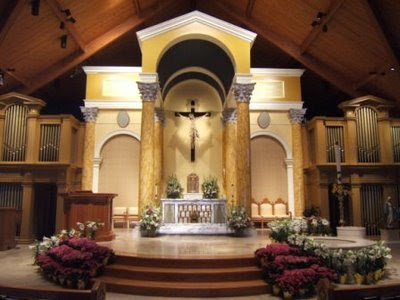 Quite amazing
Monday, June 11, 2007
Mass at Biddlestone

On Saturday I was celebrant of a traditional Mass at Biddlestone chapel. This is an annual event organised by Jack Harvey the redoubtable `convenor` of the indult Mass at St Dominic`s, Newcastle. I think I have been the celebrant every year since it started as probably not that many clergy are sufficiently fanatical to drive for over an hour to what is a very remote spot in Northumberland on a Saturday lunchtime. The chapel is all that remains of Biddlestone Hall, the home of the recusant Selby family since the fourteenth century until its demolition in the 1950`s. The chapel itself dates from the 1820`s and as the picture shows is built on the base of a medieval pele tower. Mass was said there until the 1970`s.
In the past the chapel has been packed for this Mass but this year, despite the glorious weather, numbers were down somewhat. I forgot my camera and then found the person I`d hoped would have a camera wasn`t there so I have no photos of the Mass. After the Missa Cantata, most of the congregation stayed to have a picnic lunch. There are no facilities at Biddlestone, not even running water, but so far it has never rained and I hope that we will be there again next year. A retiring collection raised £75 for the upkeep of the chapel.
My next foray into Northumberland will be for the twelfth annual traditional Mass at Brinkburn priory in September.
Searching for a Cardinal
Damian Thompson yesterday had an interesting article about the absence of Cardinal Murphy O`Connor from the premier of a new Mass setting by the pianist Stephen Hough which was sung at Westminster Cathedral yesterday. No doubt he`ll be there to hear the controversial performance of the Taverner setting of the 99 names of Allah on June 19th! However Ruth Gledhill in today`s Times has an article about the search for a successor to the Cardinal when he eventually steps down. It is interesting to note that Archbishop Kevin MacDonald is the joint favourite to succeed along with Archishop Vincent Nichols, according to Paddy Power. Well whatever happens I don`t suppose things will change much whoever gets chosen to manage our gentle decline. I can`t see us getting a Pell-like figure who might shake things up. However I did meet a priest last year from somewhere in the south who was convinced that we might get Pell himself in Westminster! That might be interesting.
Sunday, June 10, 2007
Evangelium

I am glad to report that our Evangelium course( produced by the CTS) has finally got off the ground. I had hoped to start in January but the need to acquire a lap top and a data projector slowed things down somewhat. So far we have had three meetings at SS Peter and Paul`s, Longbenton and have looked at the first two sessions in the course ( after an introductory meeting). I had worried that the material was not enough to last an hour but the first session lasted 90 minutes! I`m not sure how many people are following the course as numbers have varied between eight and twelve. We have two people who are seeking to become Catholics but as they can`t make all the sessions I will have to supplement the ones they miss with the more traditional converts` meetings. However the material is great to use and the art work is a joy. The discussions have been interesting and even life-long Catholics have said they have learnt something new. It would have been great to have had thirty or forty people attending but we live in hope. If anyone is thinking of using Evangelium I can thoroughly recommend it.
On another note I was interested to read in the Pope`s book on Jesus that evangelium was the term used by Roman emperors for their public decrees (p. 46-7). I`d never come across this before and can find no reference to it in the Oxford Latin dictionary or Lewis and Short.
Comments
Sorry to say that I haven`t been alerted to recent comments by the customary email. This means that if you comment on an article that is slightly older I may not find it. I`ll have a look at the set up to see that all is as it should be.
Saturday, June 09, 2007
Blair may seek to become deacon
The Daily Mail had the following story today!
Blair 'may become a Catholic deacon'
Visit to Vatican to see the Pope as last trip before quitting No10 'is highly significant'By JONATHAN OLIVER and MARTIN DELGADO -
Visit to Vatican to see the Pope as last trip before quitting No10 'is highly significant'By JONATHAN OLIVER and MARTIN DELGADO -
Tony Blair has discussed becoming a Roman Catholic deacon when he quits office.
The revelation comes as he prepares to meet the Pope amid speculation that he will use the audience in the Vatican to announce his conversion.
In his last foreign engagement, just days before he leaves Downing Street for the final time, the Prime Minister will visit Pope Benedict XVI in what officials say will be a "highly significant" personal mission.
It is thought that Tony Blair will announce his conversion to Catholicism when he meets the Pope. Reports that he will convert from the Church of England to the Catholic faith of his wife Cherie have often surfaced during Mr Blair's decade in office.
The claims were supported by revelations that he has already discussed not only converting to Rome, but also taking a formal lay position within the Church.
Deacons are just below priests in the Catholic hierarchy and have the right to administer certain sacraments and wear a special white robe known as a dalmatic.
Mr Blair discussed the idea of his taking such a role with Canon Timothy Russ, priest at the Immaculate Heart of Mary near the Prime Minister’s official country residence, Chequers.
The revelation is contained in a new book soon to be serialised by The Mail on Sunday – The Darlings Of Downing Street by Garry O’Connor.
The book states: "Tony expressed his strong desire when he stepped down to become a deacon – and a Roman Catholic deacon at that, confirming the often-speculated belief that he would convert to Roman Catholicism sometime in the future."
Mr Blair is reported as asking his confidant Father Timothy: "Would this be possible?" He was told: "It usually takes two or three years", to which he replied: "The fact that I'm PM, could this make a difference?"
The deacon idea emerged in a conversation a few years ago about Mr Blair's plans after he leaves office. Father Timothy suggested that taking on a formal role in the Church could give him fresh moral clout when he campaigns on climate change and Africa. The priest added: "He has a lot of potentiality for good. He is still looking for the meaning in his life."
The Blairs stopped attending Mass at the Immaculate Heart of Mary last year for "security reasons". The relationship with the priest became strained after he spoke out against the Iraq War, accusing the Prime Minister of moral surrender.
It is understood that Mr Blair will be accompanied by Cherie at the audience with the Pope in the papal apartments a week on Saturday. The couple are expected to spend the weekend in Rome before returning for their last 72 hours in Downing Street.
It will be Mr Blair's third visit to the Vatican in four years and a source said: "The fact that he will meet the Holy Father for his last official overseas engagement is highly significant and must raise speculation over his conversion to Catholicism."
The latest revelations follow recent comments by Father Michael Seed, who provides private Masses for the Blairs in their Downing Street flat.
The priest, known for bringing high-profile politicians and aristocrats into the Catholic fold, believes Mr Blair is poised to join the Church of Rome.
Converts are usually welcomed into the Church at the Easter Vigil Mass, held the night before Easter Sunday, but these arrangements are considered flexible.
Admittance to the Church is normally a two-year process. But Mr Blair, because he is already a regular attender, is likely to be fast- tracked.
As a deacon, he could help priests administer Mass, preside over baptisms and read the gospel in Church services. Unlike priests, deacons are not required to take a vow of chastity.
Mr Blair, whose children have been brought up as Catholics, regularly attends Mass at Westminster Cathedral and has become close to the leader of Catholics in England and Wales, Cardinal Cormac Murphy-O'Connor.
The Prime Minister's first meeting with the present Pope took place last June, but he had an audience with Pope John Paul II in February 2003, shortly before the US and British-led invasion of Iraq.
It later emerged that the Prime Minister had received Holy Communion from the Polish-born pontiff at a private service for the Blair family in the Vatican.
Mrs Blair, who is a devout Catholic, had an unexpected meeting with Pope Benedict last year when she was on a speaking engagement in Rome.
In 1996 Cardinal Basil Hume, the late Archbishop of Westminster, asked that the Prime Minister – a member of the Church of England – cease taking Communion at his wife’s London church in Islington.
Mr Blair is not believed to have received the sacrament in British Catholic churches since then. However, he is understood to have taken the Eucharist during holidays in Italy where an Anglican church was not easily available.
Mr Blair has always been reluctant to discuss his religious beliefs. Alastair Campbell, his former Downing Street communications chief, famously told one interviewer: "We don't do God."
A Downing Street spokesman said: "It is true that the Prime Minister will visit the Vatican. But I am not going to confirm the date. He will discuss various issues with the Pope including inter-faith issues, the Middle East peace process and international development and aid."
President Bush proved himself less than familiar with Catholic etiquette when, on his way home from the G8 summit in Germany, he stopped for an audience with the Pope in the Vatican.
First he failed to bow before shaking hands, saying: "It's great to be here."
Then officials cringed as he repeatedly called the Pontiff 'sir'. Later, a Vatican spokesman said: "I don't think President Bush meant anything by his use of words. The expression "sir" is widely used in English and especially by Americans – but of course the correct term is "Your Holiness"."
Friday, June 08, 2007
Benedict XIV

Since coming across Benedict XIV while studying for a canon law licence, I always thought he sounded like a pope I`d like to know more about. I learnt that he had an interest in the liturgy and had sought to preserve the purity of the oriental rites in communion with Rome. He had also introduced the figure of the Defender of the Bond in marriage cases to make sure the bond itself got a fair hearing. However it was only a couple of years ago while looking through second hand bookshops in York that I found Haynes` `Philosopher king: The humanist pope Benedict XIV` It took me a while to get round to reading it but I did so earlier this year. There was a lot to enjoy in the book. It was his fair-minded and moderate approach that I found appealing. My heart sank somewhat on finding four chapters (out of twelve) dedicated to his famous work on beatification and canonization which I thought would be rather dry but they were anything but as they analysed the criteria for determining when a miracle is really a miracle and how to judge whether an incident is truly supernatural. Haynes book had only a little to say about Benedict`s liturgical interests however.
Some incidents give a flavour of the man. The conclave which elected him in 1740 lasted six months. Lambertini was put forward as a compromise candidate and addressed the conclave saying : "If you wish to elect a saint choose Gotti; a statesman, Aldobrandini; an honest man, elect me". ( Haynes translates what she says is a Bologonese term as `booby` whereas `honest man` is the Catholic encyclopedia`s version). He was renowned for his witty conversation but also could shock visitors by his use of `uncardinalish expletives` which he eventually tried to restrain. It was interesting to see his assessment of Henry Stuart, the Cardinal brother of Bonny Prince Charlie. Haynes records he said `if all the Stuarts were as boring as Cardinal York he did not wonder that the English had driven them out`. As for the Polish bishops he said they were `inclined to drink much and think little`.
He was praised by Horace Walpole and Voltaire. Voltaire on one occasion penned the following lines:
`Lambertinus hic est Romae decus et pater orbis
Qui mundum scriptis docuit, virtutibus ornat`
I`m sure there are many reasons why Cardinal Ratzinger took the name Benedict. I wonder if the character of Benedict XIV, with his love of learning and self-effacing nature, was one of them.
Some incidents give a flavour of the man. The conclave which elected him in 1740 lasted six months. Lambertini was put forward as a compromise candidate and addressed the conclave saying : "If you wish to elect a saint choose Gotti; a statesman, Aldobrandini; an honest man, elect me". ( Haynes translates what she says is a Bologonese term as `booby` whereas `honest man` is the Catholic encyclopedia`s version). He was renowned for his witty conversation but also could shock visitors by his use of `uncardinalish expletives` which he eventually tried to restrain. It was interesting to see his assessment of Henry Stuart, the Cardinal brother of Bonny Prince Charlie. Haynes records he said `if all the Stuarts were as boring as Cardinal York he did not wonder that the English had driven them out`. As for the Polish bishops he said they were `inclined to drink much and think little`.
He was praised by Horace Walpole and Voltaire. Voltaire on one occasion penned the following lines:
`Lambertinus hic est Romae decus et pater orbis
Qui mundum scriptis docuit, virtutibus ornat`
(Here is Lambertini, the glory of Rome and the father of the earth, who teaches the world by his writings and adorns it with his virtues)
When this was presented to the Pope someone present complained that hic did not scan as it should always be a long syllable. The Pope replied that although he had not read Vergil for fifty years he could remember one line in which the poet scanned it as long and another where it was short!
In response to Walpole`s praise he remarked that he was `like the statues on the facade of St Peter`s which appear better when seen from a distance.`I`m sure there are many reasons why Cardinal Ratzinger took the name Benedict. I wonder if the character of Benedict XIV, with his love of learning and self-effacing nature, was one of them.
Sunday, June 03, 2007
Chant Sunday
Today, being the first Sunday of the month, we had Chant Sunday. For a change from Mass XVIII we introduced the Kyrie from the Missa de Angelis and had the Ite missa est also from the same Mass as well as Mass XVIII for the Sanctus and Agnus Dei. I`m glad to report that the parts from the Missa de Angelis were sung with enthusiasm. Maybe next time we`ll use the Sanctus and Agnus Dei from that Mass too. Maybe after a few months of that Mass we can move on to try some other settings. Thanks again to Ian Graham and the ladies of the choir for leading the singing.
Subscribe to:
Posts (Atom)