Thursday, March 13, 2008

Cardinal Dario Castrillon Hoyos to Celebrate Pontifical High Mass in the Traditional Latin Rite in Westminster Cathedral, Saturday 14 June 2008


I received this very good news today from the LMS. What a marvellous event this will be and a clear signal that the Extraordinary Form is here to stay.


The Latin Mass Society is proud to announce that Cardinal Dario Castrillon Hoyos, President of the Ecclesia Dei Commission in Rome and Prefect Emeritus of the Congregation for the Clergy, has accepted its invitation to celebrate a Pontifical High Mass in the Traditional Latin Rite (the Extraordinary Form) in Westminster Cathedral on Saturday 14 June at 2.00 pm.

Cardinal Castrillon Hoyos is one of Pope Benedict XVI’s closest collaborators and is charged with oversight of the Vatican’s relations with the religious communities and laity committed to the Extraordinary Form of the Roman Rite.

Cardinal Castrillon Hoyos will arrive in London on Friday 13 June in time to attend a private dinner given in his honour by Mr Julian Chadwick, Chairman of the LMS.

The LMS hopes to arrange for Cardinal Castrillon Hoyos to call on Cardinal Cormac Murphy-O’Connor, Archbishop of Westminster, at Archbishop’s House close to the Cathedral on Saturday morning. Cardinal Castrillon Hoyos will then deliver an address at the LMS’s AGM in Westminster Cathedral Hall later in the morning. He will then take lunch with the LMS’s Committee members before celebrating Mass in the Cathedral at 2.00 pm.

As befits a Prince of the Church, Cardinal Castrillon Hoyos will be welcomed at the Cathedral west door in full cappa magna before processing to the Blessed Sacrament Chapel to pray; he will then vest in the sanctuary whilst the Cathedral choir sings. Pontifical High Mass will then be celebrated at the High Altar with all the breathtaking ceremony and music integral to the Traditional Rite. Cardinal Castrillon Hoyos will also preach.

Julian Chadwick, Chairman of the LMS, said, “This is the highlight of the LMS’s 43 years of struggle on behalf of the Traditional Latin Rite. It will be the first time since the liturgical changes of 1969 that a Cardinal will have celebrated the Extraordinary Form in Westminster Cathedral [Note: Cardinal Alfons Stickler, Vatican Librarian Emeritus who died in December last year, presided at a High Mass in the Cathedral organised by the LMS in 1992 but did not celebrate]. Cardinal Castrillon Hoyos has been unstinting in his work on behalf of the Extraordinary Form and this Mass is a clear signal from Rome that it wants the Traditional Rite reinserted into the heart of the Church’s liturgical activity. We are extremely grateful to Cardinal Cormac Murphy-O’Connor for readily agreeing to this Mass and to Mgr Mark Langham, the Cathedral Administrator, and all his staff for their help with all the arrangements. This Mass literally represents the prayers of many thousands of LMS members and supporters offered up through the years and now come true.”

. . . . ENDS . . . .

For further information, please contact John Medlin, General Manager, or James Murphy, LMS Office Manager, on (T) 020 7404 7284; (F) 020 7831 5585;
(E mail) thelatinmasssociety@snmail.co.uk

Wednesday, March 12, 2008

Sarum Talk

Thanks to those who have written to ask how my talk on `The Sarum Use and the Recusants` went last week at the North East Catholic History Society. It seemed to go down well enough and I have been asked to write it up for the Society magazine which I will do soon before I forget it all. My greatest fear, apart from not having enough material, was that my technology would let me down and I wouldn`t be able to show the YouTube extracts from Fr Sean Finnegan`s Merton College Mass. It was a close run thing but finally I managed to get both the laptop and digital projector to do as I wanted and the clip was shown.

Fra Matthew Festing


I was delighted to read yesterday on Holy Smoke that Fra Matthew Festing has been elected as the new Grand Master of the knights of Malta. Fra Matthew lives in Northumberland and so not only succeeds the previous Grand Master Fra Andrew Bertie as only the second Englishman to be appointed to this position but he is also the second person from this diocese to hold it as Andrew Bertie was from Hexham. Fra Matthew is well known in this diocese through his work for Sotheby`s.

What with Leo Darroch as head of International Federation Una Voce and now Fra Matthew as head of the Knights of Malta, Hexham and Newcastle is doing well in high places in the universal Church!
Here is the news as announced on the Knights` website. For background on who the Knights of Malta are click here.
Frà Matthew Festing Elected Grand Master
Rome, 11 March 2008
Frà Matthew Festing, 58, an Englishman, becomes the 79th Grand Master of the Sovereign Military Hospitaller Order of St John of Jerusalem of Rhodes and of Malta, elected this morning by the Council Complete of State (the Order's electoral body). In accepting the role, the new Grand Master swore his Oath before the Cardinal Patronus of the Order, Cardinal Pio Laghi, and the electoral body. He succeeds Frà Andrew Bertie, 78th Grand Master (1988-2008), who died on 7 February.


The new Grand Master affirms his resolve to continue the great work carried out by his predecessor. Fra' Matthew comes with a wide range of experience in Order affairs. He has been the Grand Prior of England since the Priory's re-establishment in 1993, restored after an abeyance of 450 years. In this capacity, he has led missions of humanitarian aid to Kosovo, Serbia and Croatia after the recent disturbances in those countries, and with a large delegation from Britain he attends the Order's annual pilgrimage to Lourdes with handicapped pilgrims.


Educated at Ampleforth and St. John's College Cambridge, where he read history, Frà Matthew, an art expert, has for most of his professional life worked at an international art auction house. As a child he lived in Egypt and Singapore, where his father, Field Marshal Sir Francis Festing, Chief of the Imperial General Staff, had earlier postings. His mother was a member of the recusant Riddells of Swinburne Castle who suffered for their faith in penal times. He is also descended from Sir Adrian Fortescue, a knight of Malta, who was martyred in 1539.


Frà Matthew served in the Grenadier Guards and holds the rank of colonel in the Territorial Army. He was appointed OBE (Officer of the Order of the British Empire) by the Queen and has served as her Deputy Lieutenant in the county of Northumberland for a number of years.
In 1977 Frà Matthew became a member of the Order of Malta, taking solemn religious vows in 1991.


As well as his passion for the decorative arts and for history, for which his encyclopaedic knowledge of the history of the Order is legendary, as is his very British sense of humour, Frà Matthew spends any free time possible in his beloved Northumberland countryside.

Tuesday, March 11, 2008

Bishop Kevin Dunn is laid to rest


Last night I went to the cathedral for the reception of the body of Bishop Kevin Dunn. I couldn`t make it to the funeral Mass today as we were interviewing for a new headteacher at our primary school. I must say that last night was the cathedral at its best. I was pleased to see unbleached candles used for the `big six` and for the candles round the coffin. The music was not of the type that has diminished my enthusiasm for attending cathedral Masses of late. (I went once to the chrism Mass in the 1990`s but found the music so inappropriate that I didn`t go again to the chrism Mass until bishop Kevin came. At least the improvising trombone was no longer in evidence as it was in the 90`s but the music was still largely of the `folk` variety. For an account of last year`s Mass click here.) It was a shame the statues were not covered for passiontide. We had the chant Introit for the Requiem Mass to start with, the Libera me from Faure`s Requiem at the offertory and the Agnus Dei from Mozart`s Coronation Mass. What with bits of Latin chant, incense and torchbearers for the eucharistic prayer it reminded me of St Mary`s Forest Hall on a Sunday morning!


I have been amazed by the whole thing. I was firstly amazed when I heard that Kevin Dunn was going to be our new bishop as I had known him during my two years at the English College in Rome when he was doing his doctorate in canon law and I was there for the licence. Having known him in that time I never felt constrained in talking to him and felt I could say what I felt in what has been a turbulent couple of years. I am also amazed that he is no longer with us. The last thing I expected was that he might die after only three and a half years as bishop. He always looked so well and full of life. He also packed quite a lot into his time here. I was very glad that he saw upgrading the very inadequate Catholic church on Holy Island to make it a place worthy of its heritage as one of his first priorities. The makeover is a vast improvement. Maybe one day we`ll get Duncan Stroik over to build a basilica but in the meantime things have improved. I don`t think Bishop Kevin was that keen on the Extraordinary Form of the Roman Rite but he didn`t try to cancel any of the current Masses we have.


One of the good things about bishop Kevin was that he had worked as a parish priest. This is a rarer quality than might be expected among a number of people who are in charge of forming secular priests and leading them.


Extracts from last night`s Mass can be heard on the diocesan website.


May he rest in peace.

Wednesday, March 05, 2008

H & N`s own Fr Z


Naturally our diocesan website is primarily concerned with the death of our bishop but under the other news section this week`s podcast is by our own Fr Z (and that`s pronounced `Zed` : rhymes with Ted), Fr Zielinski, the judicial vicar and my boss at the tribunal (there are only the two of us and our secretary). I know he has worked hard at producing this so it would be a shame for it to go unnoticed: he offers reflections on the Gospel for the Fourth Sunday of Lent.
Sorry this podcast seems to have gone now as it is updated each week.

More on the diocesan adminstrator

I`ve been asked recently to provide some more information on the role of the diocesan administrator. So here goes

Canon 427 says that the DA is bound by the obligations and enjoys the power of a diocesan bishop, excluding those matters which are excepted by the nature of things or by the law itself.

Thus the DA, if he is not a bishop, cannot carry out pontifical ceremonies, he cannot grant incardination or excardination, unless the see has been vacant for a year and he has the consent of the college of consultors (c. 272) Likewise he cannot appoint pastors until the see has been vacant for a year (c. 525.2). (So no clergy moves for a year.)

Other things a DA cannot do are:
- to approve diocesan associations of the faithful (c. 321.1.3)
- to entrust a parish to a clerical religious insitiute or clerical society of apostolic life (c. 520.1)
- remove the judical vicar and adjutant judicial vicar (c.1420.5)
- confer a canonry (c.509.1)

Things a DA can do but only with the consent of the college of consultors
- to remove the chancellor and other notaries (c.485)
- to issue dimissorial letters for ordination but never to those who have been denied orders by
the diocesan bishop (c.1018)

C.428 says nothing new is to be done and the DA cannot do anything prejudicial to the diocese or episcopal rights. He is also specifically prohibited, whether personally or through another, from removing or destroying any documents of the diocesan curia or from changing anything in them.

C 429 says the DA is obliged to live in the diocese and to say a Mass for the people each week. Theses are also obligations of a diocesan bishop.

The DA can only be removed by the Holy See. He can resign and he presents the resignation to the college of consultors. If he is removed, resigns or dies then the college of consultors is to elect another. (c.430)

So that`s about it. The basic thing is that the DA is just watching the shop until the new bishop comes along.

Monday, March 03, 2008

Novus Sanguis

Novus Sanguis is the website of the project co-founded by Professor McGuckin and his team in Newcastle University, Great Britain, and the Foundation Jérôme Lejeune in Paris, France. It aims to use cord blood cells for stem cell research with all the benefits that can bring while being acceptable from a Catholic point of view. Dr Nico Forraz, a parishioner here at Forest Hall, is Prof. McGuckin`s colleague and recently made me aware of this new website.

Bishop Kevin Dunn was eager to support their work. Nico and Colin make regular trips to the Vatican too where there is much interest in this important work.

Funeral Arrangements for Bishop Kevin Dunn

I`m sorry to say I won`t be able to go to the Requiem Mass as we are interviewing for a new headteacher for our primary school that day but I hope to be able to get to the Monday night Mass
From the diocesan website.
Funeral Arrangements for Rt Rev Kevin J Dunn
at St Mary’s Cathedral, Newcastle upon Tyne

Reception
Bishop Kevin’s body will be received into St Mary’s Cathedral on
Monday 10th March 2008 at 7.00 pm
with the celebration of Mass, followed by a vigil of quiet prayer ending with
Compline at 10.00 pm

This Mass and Vigil of Prayer is open to all people who may wish to attend.
----------
Requiem Mass
Bishop Kevin’s Requiem Mass will be celebrated at St Mary’s Cathedral
on Tuesday 11th March 2008 at 12.00 noon
Burial will follow immediately in the Cathedral Crypt

Unfortunately, due to the seating capacity in St Mary’s Cathedral, it is not possible for this Mass to be open to everyone and therefore entrance is by ticket only. Standing space may be available in the Cathedral precincts and courtyard and loudspeakers will broadcast the Mass outside.
----------
Clergy from other Catholic Dioceses
Any priest wishing to concelebrate at either of the above Masses is asked to contact Bishop’s House on 0191 228 0003 or e-mail office@rcdhn.org.uk by Friday 7th March
-----------
Flowers
Donations in lieu of flowers may be given for the Critical Care Unit at the Freeman Hospital. Cheques to be made payable to ‘Bishop Kevin Memorial Fund’ and sent to Bishop’s House, East Denton Hall, 800 West Road, Newcastle upon Tyne, NE5 2BJ
----------
Transport
Please note that car parking is only available in the public car parks throughout Newcastle City Centre. The nearest ones are Times Square Car Park and Grainger Town Multi-Storey. For those travelling by train, Central Station is opposite St Mary’s Cathedral.

Diocese of Hexham and Newcastle: what happens now?

On the death of a bishop the governance of a diocese falls on the auxiliary bishop until the college of consultors ( a body of priests which is chosen to advise the bishop) can meet and they can elect a diocesan administrator. As we don`t have an auxiliary bishop then the college of consultors had governance until they elected an administrator.

Our college of consultors met yesterday afternoon and the former Vicar General, Canon Cunningham was elected as diocesan administrator. On the death of a bishop the Vicar General and all episcopal vicars lose authority. Canon Cunningham, as diocesan administrator enjoys the power of diocesan bishop `excluding those things whch are excepted by their very nature or by the law itself`. However canon 428 says: sede vacante nihil innovetur ( `when the see is vacant nothing new is to be done`).

The judicial vicar (and associate judicial vicar) remain in office and cannot be removed by the diocesan administrator but need to be confirmed in office by the new bishop. The diocesan chancellor remains in office and can only be removed from office by the diocesan administrator with the consent of the college of consultors.

Looking back at the history of this diocese there has always been an auxiliary bishop in the diocese on the death of the bishop since 1958 when bishop McCormack died (his auxiliary was bishop Cunningham who became bishop of the diocese on July 1st 1958) until the retirement of bishop Griffiths although he retired on 25th May 2004, the day bishop Dunn was consecrated.

Most of our bishops have been buried at Ushaw.

On-line book of condolence for bishop kevin Dunn

If you haven`t yet seen this the diocesan website has an on-line book of condolence for bishop Dunn. It can be found here.

Sunday, March 02, 2008

Requiescat in Pace


From the diocesan website:

Requiescat in Pace: Rt Rev Kevin Dunn, Bishop of Hexham and Newcastle

Bishop Kevin has died very peacefully in the Freeman Hospital, Newcastle upon Tyne, at 9.30pm on Saturday 1st March.

He was surrounded by his family including his mother, Cath, aged 88. Canon Cunningham, the Vicar General, was also present and anointed him and said the Prayers for the Dying, and together with the family said the Prayers for the Dead.

The Vicar General, Canon Cunningham, said: "We are very grateful to the doctors and nurses at the Freeman Hospital for the loving care and concern given to the Bishop and his family throughout his illness."

Bishop Kevin had been admitted to hospital in February and was transferred to intensive care with pneumonia.
A full obituary and press release will follow as soon as possible.


Kevin Dunn, Bishop of Hexham and Newcastle
Requiescat in Pace

Saturday, March 01, 2008

Bishop Kevin Dunn

From the diocesan website:

Saturday March 1st

On Thursday night Bishop Kevin's family were called, to come from Staffordshire, to the hospital as his condition was described as precarious. Canon Cunningham gave him the Sacrament of the Sick on Thursday evening.


Saturday 5pm
Bishop Kevin's condition has further deteriorated. Please keep him and the family in your prayers.

Friday February 29th
Last night Bishop Kevin's family were called, to come from Staffordshire, to the hospital as his condition was described as precarious. Canon Cunningham gave him the Sacrament of the Sick yesterday evening.

Canon Cunningham has visited the hospital this morning at 7.00 am and prayed with Bishop Kevin. The news from the hospital this morning is that his condition is a little bit more stable.

Please continue to pray for Bishop Kevin, his family and Pam, his housekeeper.

Friday, February 29, 2008

LMS training course for the Extraordinary Form

I have been asked to post this press release:

29 February 2008

PRESS RELEASE FROM THE LATIN MASS SOCIETY

For Immediate Release

Residential Training Conference for Priests Wishing to Learn the Traditional Latin Rite at Merton College, Oxford, Monday 28 July to Friday 1 August 2008

The Latin Mass Society’s August 2007 training conference for priests was a great success with 47 priests attending. (It was opened by Archbishop Vincent Nichols and attended by Bishop Edward Slattery of Tulsa, Oklahoma). Many of these priests are now offering the Extraordinary Form of the Roman Rite (Traditional Rite) or are far advanced in their preparations to do so.
The LMS now announces its second Priests’ Training Conference at Merton College, Oxford, which this year will accommodate over 60 priests and seminarians and will last for a full week. This reflects feedback from priests last year who asked for more ‘hands on’ training time.

The main features of this year’s conference will be:
● two training streams, one for complete beginners
● small training groups of about 5 students to ensure one-to-one tuition
● training in the Low Mass and the Missa Cantata
● training in all the Traditional Sacraments from baptism to funerals, and including Vespers and Benediction
● lectures in Traditional spirituality and the Usus Antiquior in a parish setting; Latin, and the Traditional Calendar
● Daily Mass, Lauds and Vespers – all in the Traditional Rite
● opportunity for all priests to offer their private Masses in the Traditional Rite with a priest ‘guide’
● More accommodation for seminarians.

To provide such intense practical training in the Traditional Mass and Sacraments and to ensure a daily high standard of liturgy, the LMS will have a large training, liturgical and music staff of about 25 – all knowledgeable in their fields. Priests will be charged a low fee of £150 to cover all tuition, board and accommodation. The LMS membership is generously paying the rest of the conference costs.

Julian Chadwick, LMS Chairman, said: “We know from the highest levels in the Vatican that our training conference last year greatly impressed the Roman authorities. It is with their approval that we are organising this second conference. We hope to make this an annual event which will roll out ever increasing numbers of priests briefed in the Traditional Rite and able to take it back to their parishes.
“The LMS’s aim is to ensure that the Extraordinary Form of the Roman Rite is freely available in all the dioceses. To this end we will step up our training of priests, seminarians, choirs and servers. We will liaise closely with the bishops and seminary rectors to ensure that all who wish to learn and worship in the Traditional Rite are able to do so.”

. . . . ENDS . . . .

For further information, please contact John Medlin, General Manager, or James Murphy, LMS Office Manager, on (T) 020 7404 7284;
(F) 020 7831 5585; (E mail) thelatinmasssociety@snmail.co.uk

Wednesday, February 27, 2008

Hurrah! Valle Adurni is back

I am delighted to see that Fr Sean Finnegan is back with his Valle Adurni blog. I`m particularly happy to see his series of videos of one of his Sarum Use Masses he organised in Oxford in 1997. I went to one of them and it may have been that one. I am due to give a talk to the North East Catholic History society next Wednesday on `the Sarum Use and the recusants`, information about which has been hard to come by, despite consulting a number of people I thought might be able to help, but I think I have enough for a talk. I would have liked to have had more on 19th century attitudes to the Sarum use amongst Catholics but have found little. Two stories in particular continue to do the rounds but I can`t find a reference for them. One is that Pius IX offered the new English hierarchy the Sarum Use and they turned it down out of a desire to be thoroughly Roman and the other is that there was talk of having the Sarum Use at Westminster cathedral when it was opened in 1903. If anyone has any information on either of these stories I`d be very grateful for it.

Sunday, February 24, 2008

The Orientation of the Mass

On Tuesday nights in Lent at St Mary`s I have started a Mass with priest and people facing the same way following the example of Pope Benedict in the Sistine chapel. This is the New Mass in English but it has given rise to some unfavourable comments. This video by Fr Fessio may help to explain what is going on and why Pope Benedict thinks it is an important aspect of the Mass to re-discover.

Thursday, February 21, 2008

From Forest Hall to Forest Gate

Today I was talking to a priest friend about a priest we both know Fr Dennis Hall of Forest Gate in the Brentwood diocese. I`ve only met Fr Hall once when he came to St Wilfrid`s Gateshead to hold a `Day with Mary` but my parish sister had worked with him for a number of years. It was quite a coincidence when tonight I looked at Holy Smoke and found that he is in the news because of a wrangle over the 1962 missal in his parish.

It raises interesting issues which I hope the imminent instruction from the Ecclesia Dei office will help resolve.

Tuesday, February 19, 2008

More on bishop Kevin Dunn

From Independent Catholic News

Bishop Kevin Dunn critically ill

Parishioners across the diocese of Hexham and Newcastle are praying for Bishop Kevin Dunn, who is very seriously ill in hospital. Over the weekend, his condition deteriorated, a diocesan spokesman said.

Canon Seamus Cunningham, vicar general of the Diocese of Hexham and Newcastle, told the Sunderland Echo: "Bishop Kevin was admitted to hospital on Tuesday, February 5, and then on Friday, February 8, was transferred to intensive care with pneumonia. He is responding to treatment and the priests and people of the diocese are being asked to remember him in their prayers."

Father Bill O'Gorman, of St Michael's Church in Houghton, said: "We are very sad. The diocese is shocked to hear that he's critically ill. He's a wonderful bishop. He's been in the diocese since May 2004, coming up to four years, and has made his mark already. Every day we have prayers for him. We would wish him a speedy and full recovery."

Bishop Kevin, 57, was ordained as the 12th Bishop of Hexham and Newcastle in May 2004 by bishop Ambrose Griffiths.Born in Newcastle-under-Lyme, Staffordshire, he studied for the priesthood at Oscott College in Birmingham and was ordained at Our Lady and St Werbergh's Church in Clayton, Newcastle-under-Lyme in 1976.

Since then, he has worked mainly across the West Midlands. He studied at the Pontifical University of St Thomas Aquinas in Rome and was awarded a doctorate in Canon Law in 1991.In 2001, he was appointed full-time episcopal vicar for Wolverhampton, Walsall, the Black Country and Worcester. In 2002, he became a Canon of the Metropolitan Chapter of St Chad and a member of the Episcopal Council in the Archdiocese of Birmingham.

A message on the Hexham and Newcastle diocesan website site says: "He is being remembered and supported in prayer by so many people at this time, both in the diocese and beyond. We ask that you continue to keep him and his family and the whole of the diocese in your prayers at this time
© Independent Catholic News 2008

Sunday, February 17, 2008

Prayers Please


Our bishop, Kevin Dunn, has been suffering with kidney problems recently and has spent the last week or so in intensive care with pneumonia. He is very ill and was anointed this morning. If you are reading this, then out of kindness, please say a prayer for him. He has been bishop since 2004 and is 57 years old.
Diocesan website here.

Tuesday, February 12, 2008

Lenten Talks at St Mary`s

Tonight at 7.30pm we have the first in a series of talks on matters of Catholic interest to be given during Lent. The programme so far is:

12th February: Terry Middleton, a local historian and genealogist, will talk on the Northern Rising of 1569.

19th February: Fr David Milburn, author of a history of Ushaw College and until recently chairman of the North East Catholic History society will talk about Ushaw (which this year is celebrating its bi-centenary).

26th February: Ian Graham the director of the Schola Gregoriana of Northumbria will give a talk entitled: More than One Line: The Development of Polyphony in Liturgical Music 1300-1600.

4th March: Mike Collins, a local representative for Aid to the Church in Need will talk about the history of that organisation and the life of its founder Fr Werenfried van Straaten.

11th March: Dorothy Allen, member of the Schola Gregoriana of Northumbria and former pupil of Dr Mary Berry, on `The place of the psalms in Christian life`.

Una Voce statement on the Good Friday prayer for the Jews


I received this last night. It is interesting to note that the SSPX-affiliated Transalpine Redemptorists based on the island of Papa Stronsey in Scotland have embraced the new prayer. This will make life interesting if the SSPX itself does not. Let`s hope that this willingness to follow the Holy Father in this may lead to the Transalpine Redemptorists finding regularisation in the Church.

Foederatio Internationalis Una Voce.
Quae patronum invocat sanctum Gregorium Magnum Papam.

LEO DARROCH, Executive President.


Statement.

Good Friday Prayer for the Conversion of the Jews.

The recent Nota from the Secretariat of State on the revision of the Good Friday prayer for the conversion of the Jews has received much comment in the media; much of it unfavourable, unfortunately, from some of those for whom the revision was intended to placate. The fact that there has been a great deal of misinformation and misunderstanding from certain quarters has not helped to promote a sensible appraisal of the revision. The Jewish Journal states, “The change would affect the Missal of 1962 which the pope brought back into use.” Other Jewish sources have made the same mistake and are blaming Pope Benedict XVI for re-introducing the traditional form of Mass. This is completely untrue and indicates, perhaps, an understandable lack of knowledge about the Catholic Church which, however basic, cannot be attributed to Catholics.

It cannot be emphasised strongly enough that Pope Benedict has not ‘re-introduced’ anything. The Missal approved in 1962 was never abolished and, thus, the prayer for the conversion of the Jews has always been available in its traditional form. In his explanatory letter to the bishops that accompanied his Apostolic Letter Summorum Pontificum (7 July 2007) Pope Benedict declared “I would like to draw your attention to the fact that this Missal (of 1962) was never juridically abrogated and, consequently, in principle, was always permitted.”

A new Missal was promulgated by Pope Paul VI in 1970 (and included a revised version of the prayer) but in 1971, following receipt of a petition signed by a number of international figures, including the violinist Yehudi Menuhin, Pope Paul VI authorised the continuity of the older form in England and Wales. In 1984 Pope John Paul II, in his Apostolic Letter ‘Quattuor abhinc annos’, extended the permission to the rest of the Latin Church and stipulated that “These celebrations must be according to the 1962 Missal and in Latin”. Only four years later, because this document was found to be too restrictive, Pope John Paul II, in 1988, widened the authorisation even further through another Apostolic Letter ‘Ecclesia dei adflicta’. He declared “Moreover, respect must everywhere be shown for the feelings of all those who are attached to the Latin liturgical tradition, by a wide and generous application of the directives already issued some time ago by the Apostolic See, for the use of the Roman Missal according to the typical edition of 1962.”

It is a fact, therefore, that the prayer for the Jews has been recited in Catholic Churches around the world more or less without interruption since 1962. It is pertinent to ask why complaints were not ranged against Pope Paul VI in 1971, or Pope John Paul II in 1984 and 1988? Why has Pope Benedict been unjustly, and falsely, accused of re-introducing a prayer that was never abolished and was publicly sanctioned by two of his predecessors? It is this kind of ill-informed comment and partial approach that does nothing to help the cause of improving Judeo-Catholic relations that Pope Benedict’s accusers purport to pursue.

Pope Benedict XVI, like Pope John Paul II and Pope Paul VI before him, is the supreme authority in the Catholic Church on matters pertaining to the celebration of the Church’s liturgy, insofar as the deposit of the Catholic Faith is preserved and propagated. The revised version of the prayer for the Jews as published by the Secretariat of State on 4 February 2008 quite clearly maintains Catholic doctrine. Our Holy Father has considered this matter and given his decision. The International Federation Una Voce welcomes this decision in filial obedience and will accept the new form with immediate effect.

Leo Darroch – Executive President.
10 February 2008.

Friday, February 08, 2008

Things you don`t expect to hear: no 1


Papal Secretary of State quotes Woody Allen. (Ansa)


Cardinal Bertone has been noted for a sense of humour. He is an ardent fan of Juventus football team, and has even acted as commentator on football matches for Genoese television stations. He once observed that although the Vatican opposed human cloning, "an exception might be made in the case of Sophia Loren". Nonetheless he still caused surprise when he began a homily at a Mass to celebrate the fortieth anniversary of the San Egidio community on February 1st by quoting Woody Allen`s line ` God is dead, Marx is dead and I don`t feel too well myself`! He went on to denounce the state of mind of a large part of humanity which is apparently always more and more unhappy and less confident of the future.


Whatever next?

Thursday, February 07, 2008

At last!


Readers may already have seen the pictures of Pope Benedict`s Ash Wednesday Mass. I know some may think this is getting obsessed with details but I was very pleased to see that at last the `Benedictine reform` has reached the Pope`s chasubles. This is in keeping with his intention of stressing the continuity of the Catholic faith rather than any idea of a rupture and a beginning from scratch again. Liturgical continuity reiinforces doctrinal continuity. Thus I was pleased to see the Pope wearing this Roman style vestment for Mass yesterday for the first time since he became Pope. It was also encouraging to see the seven candles for a papal Mass now seem to be a constant feature althogh the arrangement here left something to be desired.


For more learned comments see the NLM blog. For a brief introduction to chasubles see Wikipedia

Latin in demand

This story appeared on Tuesday in the Guardian. H/T to rogueclassicism. I have heard it said that the enthusiasm is only for GCSE Latin and few follow it to A level, but who knows? I have offered to start a Latin for beginners class in the parish and there is quite a lot of interest from teenagers as well as adults. I hope to start in the next couple of weeks. Certainly my intermediate Latin class this year at Newcastle University is the biggest I have known by far.

Back in 1965, Oxford and Cambridge decreed that applicants no longer required O-level Latin to gain admission to their hallowed halls and cloisters. The following year saw the founding of the Cambridge School Classics Project (CSCP) with the aim of keeping alive not only the flickering flame of classical culture, but also a language that even some academics regarded as past its sell-by date and the preserve of a snobbish elite.

More than four decades on, something strange is happening. The demand for Latin teachers in schools is going up, while the supply is going down. "Universities aren't producing enough, so we're all scrabbling around for the same people," says Andrew Hutchinson, headteacher at Parkside Community College in Cambridge - a comprehensive serving the centre of the city. "Quite a lot of academics live around here, which means the parent body can be quite demanding." Unusually for a state school, both he and his deputy are classicists.

Hutchinson has an MA in the subject from King's College, London, one of just two universities that are still training classics teachers. The other is Cambridge. Every year, its faculty of education gives PGCEs to 15 graduates qualified to teach classics, including Latin. King's College trains another 12. A total of 27, then. Meanwhile, around 72 Latin teachers are retiring or leaving annually, according to the CSCP.

The CSCP also estimates that there has been a three-fold rise over the past seven years in Latin classes of one form or another. The subject is now taught in 1,042 schools, including 453 independents and 118 grammars. But the biggest increase has come in state comprehensives, with a total of 471. Before addressing how this has come about, perhaps King's should be asked why it is training only a dozen classics teachers annually."

Good question," says Aisha Khan, subject director for PGCEs in Latin and classical civilisation. "Our head of department recently made a bid to increase the numbers to 16, but that was turned down. We've been told by the Training and Development Agency that the figure will stay at 12 until at least 2011."

Khan's counterpart at Cambridge, Bob Lister, points out that 20 years ago there were 15 higher education providers of classics teachers. "But then 20 years ago," he goes on, "universities were happy to have PGCE courses with four or five students. Financially, that won't work now."

Times change. The number of higher civil servants with Oxbridge classics degrees is in decline just as the number of employers demanding graduates with more practical skills is increasing. What can a profound knowledge of classical civilisations offer in this brave new world? "The same benefits as any humanities degree - the ability to develop and sustain argument with reference to evidence," Lister says. "What's more, a knowledge of classical heritage is invaluable to anyone trying to understand culture in the 21st century."

Roots of English

Or the new millennium, to put it another way. Millennium is a good Roman word, and one of many that lie at the roots of English and other European languages. Ironically, the revival of an ancient language in schools has come about through modern technology. DVDs and computer terminals bring the subject to life in a way that would seem unimaginable to older generations who were forced to conjugate verbs by rote. "In 2000, the government put out a tender for software to support the teaching of Latin," says Will Griffiths, director of the Cambridge project, based on the second floor of the university's faculty of music. "One aim was to improve standards in schools where the subject was being taught by trained teachers. The other was to allow the majority of schools to be able to offer the subject through English or modern language teachers."

For the most part, the subject is taught on an extra-curricular basis to children who tend to be academically bright. "You find them in state schools all over the country," Griffiths enthuses. "I remember a girl in Dagenham who did GCSE by following our distance-learning course. The girl was highly sought after by top clubs in the field of women's football, but she turned them down to concentrate on her studies and came out with an AS in Latin by video link."

In one of its offices, the CSCP harbours a bank of screens from which one teacher, Verity Walden, holds what might be termed a video conference in Latin with some 260 schools around the country. Meanwhile, the demand grows for specialist Latin teachers on site. "They're becoming like gold dust. I sometimes receive two inquiries a day from heads looking to hire one," says Griffiths, 37, a former classics teacher at a comprehensive. "The issue for higher education is how it can support this surge in interest from schools. The government will always prioritise subjects like English and maths, but there's no reason why it shouldn't support more training for teachers in classics."

And the children who are creating the demand for those teachers - how do they see a knowledge of Latin and classical civilisation helping in their future degree and career choices?"

I think there's still an idea that a knowledge of Latin is helpful for medicine and law," says Griffiths. "That may be a misconception. But there's little doubt that Latin helps with an understanding of the make-up of English and other modern European languages. As teachers it's our job to enthuse and make that understanding a lively process."

Not an easy option

On the other side of the River Cam, dusk is drawing in and children are streaming away from Parkside Community College as Latin teacher Nicky Parr is going to work. From key stage 3 onwards, between 25 and 40 pupils in each year group stay behind after normal classes, and the numbers taking the subject at GCSE level are approaching double figures. "It's not an easy option," says Parr, "Latin is marked particularly rigorously and children have to put in long hours. It demands commitment as well as academic ability."

At least one of her pupils, Molly Makinson, 13, is also studying ancient Greek. ("My grandad used to teach it," she says.) Another, David Mestel, 15, acquired an A* GCSE in Latin in year 9. Along with Luke Freeman-Mills, currently studying A-level Latin at sixth-form college, he's producing a booklet containing translations of Virgil, Horace, Ovid and others. So does he fancy studying the subject as part of a classics degree?"

No," he says. "I will probably do something scientific." For young Mestel, it would seem, translating Latin poetry is simply a bit of fun.

Wednesday, February 06, 2008

Latin Mass Society on the new Good Friday Prayer

I received this this morning which I am happy to share.


PRESS RELEASE FROM THE LATIN MASS SOCIETY

For Immediate Release

6 February 2008

* Latin Mass Society Responds to New Good Friday Prayer

The Vatican has announced that Pope Benedict XVI has issued a new Prayer for the Jews to replace that in the Missal of Blessed John XXIII (1962). The new prayer is to be used with immediate effect.

Pope Benedict XVI when issuing his Motu Proprio, Summorum Pontificum of 7 July 2007 indicated that he would consider certain organic changes to the 1962 Missal, such as introducing a wider selection of Prefaces. The Good Friday prayer is his first change.

The unofficial translation of the new Good Friday Prayer for the Jews is:

Let us pray, and also for the Jews:
May our God and Lord enlighten their hearts, so that they may acknowledge Jesus Christ, saviour of all men.
Let us kneel…
Almighty and Everlasting God, who desirest that all men be saved and come to the knowledge of the truth; mercifully grant that, as the fullness of the Gentiles enters into Thy Church, all Israel may be saved.
Through Christ our Lord. Amen.

The new prayer was written by Pope Benedict himself and keeps the key idea of conversion to Christ. It situates the Jewish people as one group among all the groups of humankind who are offered conversion and salvation through Christ.

Although the Good Friday Prayer for the Jews had previously been revised by Blessed Pope John XXIII, some still found a hint in it that it was offered at rather than for the Jews. This possible ambiguity has now been removed.

Although some might wonder if there was indeed a pressing need to rewrite the prayer, nevertheless the Latin Mass Society in loyalty to the Holy Father’s clear wish will use the new prayer in all Good Friday services organised under its auspices.

John Medlin, General Manager of the LMS, expressed a personal opinion and said: ‘The new Good Friday Prayer for the Jews is self-evidently more concise and unambiguous than the current Prayer for the Jewish People in the 1970 Missal of Paul VI. I wonder if consideration might be given to introducing the new prayer into the 1970 Missal.’

. . . . ENDS . . . .

For further information, please contact John Medlin, General Manager, or Yvonne Windsor, LMS Office Administrator, on (T) 020 7404 7284; (F) 020 7831 5585;
(E mail) thelatinmasssociety@snmail.co.uk

Tuesday, February 05, 2008

Blog Statistics

I`ve never published one of these before but I see Fr Ray Blake has done so today so I thought I`d follow suit as it may be of interest. This blog gets about 120 visits a day.


New Good Friday prayer

Readers of Rorate Caeli will have seen that the expected new Good Friday prayer for the Jews for the Extraordinary Form has been published today by the Vatican. I have no problem with the prayer. It still clearly calls for the Jews to acknowledge Jesus Christ as the Saviour of all. I had no problem with the old prayer but if the Holy Father sees fit to make this change to remove some language which may make relations with the Jews difficult while retaining the meaning of the prayer than that is a good thing.
Another Good Thing is that it removes the claim that was made by some through an inaccurate reading of Summorum Pontificum that there was no permission for the EF in the Triduum. All that is forbidden is a private celebration which is natural enough. Yet another Good Thing is that this shows that the EF is here to stay and is a full part of the current Roman Rite.
Here is the prayer and translation courtesy of Rorate Caeli:

Oremus et pro Iudaeis. Ut Deus et Dominus noster illuminet corda eorum, ut agnoscant Iesum Christum salvatorem omnium hominum.
Oremus.

Flectamus genua.
Levate.

Omnipotens sempiterne Deus, qui vis ut omnes homines salvi fiant et ad agnitionem veritatis veniant, concede propitius, ut plenitudine gentium in Ecclesiam Tuam intrante omnis Israel salvus fiat. Per Christum Dominum nostrum. Amen.

From the Vatican, February 4 2008.

Let us pray also for the Jews.

May our God and Lord enlighten their hearts, so that they may acknowledge Jesus Christ, saviour of all men.

Let us pray.

Let us kneel.
Arise.

Almighty and everlasting God, who desirest that all men be saved and come to the knowledge of truth, mercifully grant that, as the fullness of the Gentiles enters into Thy Church, all Israel may be saved. Through Christ Our Lord. Amen.

Of course supporters of the SSPX will complain bitterly about this (cf. Angelqueen) and it will make reconciliation with them more difficult but if they really believe in the authority of the Pope it would be refreshing to see some humility on the part of the SSPX leadership, for them to really show willingness to accept the authority of the Pope and agree to use it.
This prayer came out rather quickly. I wonder how near to completion the long-awaited explanatory document from Ecclesia Dei might be?
UPDATE: 6.02.08 I thought this would not be very acceptable to Jews who were offended by the idea that the church should pray for conversion and so it seems it isn`t
Prayer for Conversion of Jews Remains Troubling Despite Vatican Changes
New York, NY, February 5, 2008 …. The Anti-Defamation League (ADL) said the Vatican's changes to the Latin Good Friday prayer for the conversion of Jews amount to "cosmetic revisions" and the prayer remains "deeply troubling" because it calls for Jews to "acknowledge Jesus Christ as the savior of all men."
Abraham H. Foxman, ADL National Director, issued the following statement:
While we appreciate that some of the deprecatory language has been removed from a new version of the Good Friday prayer for the Conversion of Jews in the 1962 Roman Missal, we are deeply troubled and disappointed that the framework and intention to petition God for Jews to accept Jesus as Lord was kept intact.
Alterations of language without change to the 1962 prayer's conversionary intent amount to cosmetic revisions, while retaining the most troubling aspect for Jews, namely the desire to end the distinctive Jewish way of life. Still named the "Prayer for Conversion of the Jews," it is a major departure from the teachings and actions of Pope Paul VI, Pope John Paul II, and numerous authoritative Catholic documents, including Nostra Aetate.
ADL wrote to Pope Benedict on January 22 expressing concern that a revised Good Friday prayer that Jews abandon their own religious identity, would be devastating to the deepening relationship and dialogue between the Catholic Church and the Jewish people.
The Anti-Defamation League, founded in 1913, is the world's leading organization fighting anti-Semitism through programs and services that counteract hatred, prejudice and bigotry.
I can`t get too excited by this as I have mentioned before that celebrating the 1962 Good Friday liturgy I discovered it is essentially the same as that of the Novus Ordo apart from using black vestments. I would be interested in using the older form, from before the changes of the 1950`s but there is no permission to do so (although rumour has it that the Institute of Christ the King have permission). I ony wish that this new prayer for the Jews could be used instead of the rather weak one in the Novus Ordo.

Monday, January 28, 2008

Archbishop Ranjith does it again

I remember hearing the reports of the discussions at the Synond on the Eucharist and being rather disappointed by it all. One of the few interesting interventions was from a bishop from Kazakhstan who suggested that receiving Holy Communion in the hand and standing may be partly responsible for the decline in devotion to the Eucharist. It made sense to me but I was only sad that the idea was only being voiced in Kazakhstan. However Bishop Athanasius Schneider, Auxiliary Bishop of Karaganda in Kazakhstan, has written a book and Archbishop Ranjith has written the preface. He concurs with the bishop`s thesis. I can`t wait for archbishop Ranjith to take over as prefect of the CDW!

Here are some relevant extracts from the preface courtesy of the NLM blog where the whole preface may be read.

At the same time, speaking of communion in the hand, it must be recognized that the practice was improperly and quickly introduced in some quarters of the Church shortly after the Council, changing the age-old practice and becoming regular practice for the whole Church. They justified the change saying that it better reflected the Gospel or the ancient practice of the Church... Some, to justify this practice referred to the words of Jesus: "Take and eat" (Mk 14, 22; Mt 26, 26).
Whatever the reasons for this practice, we cannot ignore what is happening worldwide where this practice has been implemented. This gesture has contributed to a gradual weakening of the attitude of reverence towards the sacred Eucharistic species whereas the previous practice had better safeguarded that sense of reverence. There instead arose an alarming lack of recollection and a general spirit of carelessness. We see communicants who often return to their seats as if nothing extraordinary has happened... In many cases, one cannot discern that sense of seriousness and inner silence that must signal the presence of God in the soul....
Now I think it is high time to review and re-evaluate such good practices and, if necessary, to abandon the current practice that was not called for by Sacrosanctum Concilium, nor by Fathers, but was only accepted after its illegitimate introduction in some countries. Now, more than ever, we must help the faithful to renew a deep faith in the Real Presence of Christ in the Eucharistic species in order to strengthen the life of the Church and defend it in the midst of dangerous distortions of the faith that this situation continues to cause.

This takes the biscuit


Chris Gillibrand`s tireless efforts to uncover silliness and abuses in the celebration of the sacred liturgy are remarkable. This however must be the silliest thing yet (and there is some stiff competition!). Read more about it here.

Thursday, January 24, 2008

More praise for Lancaster school document

I asked at our diocesan school department whether they had a copy of the Lancaster `Fit for Mission?` document but they said they hadn`t got it yet. Other people seem to have received it, in the Vatican. I`ve already mentioned the previous Vatican praise for this document. Now there is more. H/T to Total Catholic.

New Vatican praise for bishop's education document

A groundbreaking education document produced by the Bishop of Lancaster has received further praise from the Vatican.

Fit for Mission? Schools had previously been praised by the Congregation for Clergy.

It has now also been singled out by Cardinal Zenon Grocholewski, Prefect of the Congregation for Catholic Education, as a “reliable resource for renewing the vitality of Catholic education in today’s society”.

The cardinal commended Bishop Patrick O’Donoghue on behalf of the congregation for his “initiative and work done to strengthen the values inherent in the Catholic school”.

Cardinal Grocholewski highlighted the publication’s “comprehensive” use of documents from the Holy See to support the Catholic ethos in schools on a diocesan level.

The implementation of the Fit for Mission? Schools programme will be developed throughout Lancaster over the course of this year.

The diocese’s education centre will facilitate and co-ordinate further consultation and implementation of the action plan among primary and secondary schools, and colleges.

The consultation will culminate in a diocesan conference in November 2008 to discuss the progress of the initiative overthe year.

Bishop O’Donoghue, currently on a pastoral visit to India at the invitation of the Syro-Malabar community, said: “I am absolutely delighted with the letter from Cardinal Grocholewski.

“It is so encouraging to learn that Fit for Mission? Schools has been commended by the Congregation that has authority over all Catholic schools and colleges throughout the world.”

He added: “I see it as yet another sign that our efforts at Lancaster are moving in the right direction.

“We are honestly trying to make our schools and parishes fit for mission – striving to communicate the Gospel with a freshness and energy to young and old.”

Monday, January 21, 2008

Can King Kev save Newcastle?


While I was away for a few nights last week in Lille, the news broke and just made it onto the news on CNN on the hotel television that Kevin Keegan was returning to manage our football club. I was eager to get hold of an English paper to read about it. I was never very good at football. I`ve not been to St James` park for over ten years and when I last went I needed to ask a ten year old beside me to explain what was going on and as for the off-side rule... However I follow the progress of the club with much attention and interest and also go to the theatre a lot although I don`t even live in the south! (Cf. KK`s remarks at the press conference.) It has been said that football in Newcastle is different to elsewhere in the country as the fortunes of the club appear to influence the life of the whole city.


I read when I got home that shortly after the news of Kevin Keegan`s return was announced a couple named their new born son Kevin Keegan. This made me think back to confirmations here in Forest Hall in the autumn conducted by our own bishop Kevin Dunn. He remarked sadly that no-one had chosen Kevin as a confirmation name. We`ll have to wait and see but next time he comes for confirmation in a few years time he may find a whole row of Kevins waiting to be confirmed (and maybe even a couple of Alans).

Sunday, January 20, 2008

Christian Unity Week

I`m afraid it has been a rather uneventful Christian Unity week this year even if it is the centenary of the first one. As I have mentioned before my last experience of it was in 2005 when I went to the service in Gateshead at the C of E Christ church where the bishop of Durham was the preacher. I was the only Catholic priest present as far as I could tell but there was no shortage of Anglican clergy and a lady vicar in choir dress led the service.

How strange to be back in the very same church on Saturday as I popped in to see bishop Fellay`s blessing of that church for the use of the Society of St Pius X. I thought that, given that he is the head of that organisation it might be interesting to hear what he had to say. So after the blessing of the church he stood in that same pulpit where I had seen bishop Tom Wright of Durham preach and he talked for about an hour. The first half offered reflections on the symbolism of the rite of blessing a church and the place of the sacraments in Catholic life. In the second he gave us his reflections on the Motu proprio. Having heard what he had to say I must say my thought was that reconciliation with the Holy See and the SSPX looks as unlikely as ever.

Whereas Pope Benedict in his accompanying letter to the Motu Proprio wrote: There is no contradiction between the two editions of the Roman Missal, bishop Fellay appears to see the two forms of the Roman rite as being mutually exclusive which is ironically quite similar to the outlook of `liberal` Catholics who oppose the Motu Proprio or make it difficult to be implemented as they too see the two forms as being opposed to each other.

I stayed for some of the Mass which was beautifully done except that the choir had not made it because of trouble with the trains and so the music wasn`t what had been intended. I said a prayer for reconciliation and pray that this division may not harden as Pope Benedict mentioned in the letter accompanying Summorum Pontificum when he wrote:

Looking back over the past, to the divisions which in the course of the centuries have rent the Body of Christ, one continually has the impression that, at critical moments when divisions were coming about, not enough was done by the Church’s leaders to maintain or regain reconciliation and unity. One has the impression that omissions on the part of the Church have had their share of blame for the fact that these divisions were able to harden. This glance at the past imposes an obligation on us today: to make every effort to enable for all those who truly desire unity to remain in that unity or to attain it anew.

Sunday, January 13, 2008

This makes me so happy

As readers may have read elsewhere today the Holy Father celebrated Mass in the Sistine chapel this morning but this time the temporary altar for celebrating facing the people was removed and the original altar of the chapel was used instead. Here is a picture courtesy of the NLM blog. It is very encouraging to see the Mass celebrated like this after there has been much written recently, not least by Cardinal Ratzinger himself, about the need to restore this orientation in the Mass. For anyone who is unfamiliar with the issues involved a good introduction can be found here.
I fervently hope that we will see the Pope celebrate Mass like this more often as it will encourage others (myself included) to follow his lead. So far we have read the books and a few brave souls have taken on this practice but with these pictures there is much more encouragement.
In Summorum Pontificum there is mention of the extraordinary form influencing the ordinary and vice versa. Although this orientation has never actually been forbidden for the Paul VI missal (and the rubrics in a few places seem to expect it, as in the priest turns to face the people and says `Behold the Lamb of God`) many churches have been `re-ordered` with varying degrees of iconoclasm on the supposition that this was required by Vatican II. However as the EF is celebrated with this orientation most of the time and the OF is normally celebrated `facing the people` this would be one example of the EF influencing the OF. Maybe we can start an experimental OF like this once a week in the Forest after appropriate catechesis.

Thursday, January 10, 2008

Church and state

These two stories struck me as interesting. In Slovakia a radio station has been fined for making fun of the Vatican`s document on road safety while in Spain the government asks for the country`s bishops to apologise for holding a day to celebrate the family. It seems to me that both of these reactions are somewhat extreme.

Spanish leaders want bishops' apology for pro-family rally
Madrid, Jan. 3, 2008 (CWNews.com) - Spanish government leaders have asked the country's Catholic bishops to apologize for the massive pro-family rally held in Madrid on December 30, Vatican Radio reports.

Leaders of the Socialist governing party have charged that the Church intervened in partisan political affairs with the rally, which drew nearly 2 million participants. (The government is reporting that only 160,000 took part in the demonstration.) The government has asked the bishops' conference for an apology.

Although 40 bishops took part in the pro-family event, and the hierarchy gave clear support to the event, the rally was organized primarily by lay Catholic activists. The organizers have consistently argued that the rally was not intended as a partisan political event, but as a public expression of support for the traditional family founded on Christian marriage.

Slovak station fined for criticizing Vatican's “ten commandments” of driving

Bratislava, Jan 10, 2008 / 04:02 am (CNA).- A Slovakian television station has been fined two-million koruna ($88,400), for making fun of a Vatican document on Christian driving, Agence France Presse reports.

Slovakia’s broadcasting council said that a program on the commercial station Joj abused viewers’ religious sensibilities and was not objective.

The program targeted the 2007 document issued by the Pontifical Council for Migrants “Guidelines for the Pastoral Care of the Road,” widely characterized by media reports as teaching the “Ten Commandments” of driving.

The program said that priests were “not the best experts” to give instructions on driving because the Vatican had "only two kilometers of highway and the last traffic accident was more than half a year ago."

Around two-thirds of Slovakians describe themselves as Catholic.

Wednesday, January 09, 2008

Zielinski speaks

I apologise for once again lifting an article from Rorate Caeli but I know not all those who read this read it. Here are the words of the Most Rev. Abbot Dom Michael Zielinski, O.S.B. Oliv., Vice-President of the Pontifical Commission for the Cultural Heritage of the Church as reported in today`s Osservatore Romano. I`ve tried to do my bit to encourage chant in the Forest but it takes time for it to become familiar. I was talking to some parishioners today who said that after hearing it a few times they began to enjoy it, so we soldier on.

Despite the pronouncements of the Vatican II Council and of the papal magisterium, Church music is in crisis; it is affected by the hermeneutic of discontinuity and rupture, of which Benedict XVI spoke in his Address to the Roman Curia of December 22, 2005.


To recover the great treasure which the Tradition of the Church gave to us, it is necessary to begin with Gregorian Chant, which is capable of communicating to the People of God the sense of Catholicity and to guide it towards a correct inculturation.


German writer Martin Mosebach recalls that this music was peculiar also to the ears of Charlemagne, of Saint Thomas Aquinas, of Monteverdi, or of Haydn. And it was as strange in their age as it is in our age. Today, however, one is more inclined towards the music of other cultures than the Christians of many centuries ago. Besides, the melodies of the various local traditions, even of those of cultures different from ours, are close relatives of Gregorian chant and, even in this sense, Gregorian Chant is truly universal.

Tuesday, January 08, 2008

Mass from Highfield in 1967

I was recently given a cassette tape recording of a BBC radio broadcast of the Sunday Mass of November 27th 1967 from St Joseph`s, Highfield, near Rowlands Gill. The celebrant was Fr Hugh Lavery, one of the finest preachers and spiritual writers of this diocese in recent times. However it is a fascinating record of the changes in the Mass at that time.
The Mass appears to be a Missa Cantata in that the proper is sung by some very well-spoken girls but other elements such as the prayers and the Our Father are said . The whole Mass is in English apart from the canon which is said aloud in Latin. A lay reader reads the Epistle and bidding prayers and there are a couple of hymns too. The Introit and Communion antiphons are sung with extended psalm verses.
I can imagine there was great excitement at the time about these changes (although for a different reaction see Evelyn Waugh`s reaction in the book `A Bitter Trial`) as it represented the fulfilment of the hopes of the Liturgical Movement and the culmination of a process which had been at work throughout the 20th century to restore the liturgy and free it from the accretions of centuries. Certainly everyone on the tape (including the commentator) sounds quite excited by it all. However I think I`d be with Evelyn Waugh on this one.

The Saint Lawrence Press


I recently received a copy of the ordo for 2008 published by the Saint Lawrence Press. This ordo follows the 1939 edition of the Roman missal. If you would like to know more about it, there is a website here. Readers of this blog will have seen the comments on the post about the new SSPX church in Gateshead where this frst came to my attention. The ordo looks formidable at first and takes a bit of deciphering when it is unfamiliar. There is a sample page with explanation here.

It is a fascinating insight into the Roman rite before the reforms of the 1950`s and 1960. The site offers a comparison between different editions of the Roman rite since 1570 which is also very interesting.

Fr Demets in his talk to the clergy of Little Rock mentions that within the Priestly Fraternity of St Peter there are some who prefer the pre-1962 Roman missal. The Institute of Christ the King are said to have permission to celebrate the pre-reform Holy Week services too. However as I mentioned in the comments box it is enough of a struggle to get the 1962 missal up and running at the minute without complicating things further. However I am enjoying looking at this ordo every day to see what was in the norm in 1939.

When I was at seminary it was not unusual for an attachment to the `Tridentine` missal to be attacked on the grounds that those who liked it valued it for the sense of liturgical immutability and continuity it gave whereas in fact the Roman missal of 1570 missal was not identical to that of 1962. Here we can, with the help of the comparison table, follow those changes. However the changes between 1570 and 1962 are fairly cosmetic compared to that of the 1970 Novus Ordo and the sesnse of following an unbroken tradition is stronger in the 1962 missal than that of 1970.


Sunday, January 06, 2008

More from Lancaster

I don`t understand why it would be a cause for regret that the organ could not accompany the singing at a Requiem as it is meant to be sung without accompaniment but it`s good to see a regular EF Mass at a cathedral. How enlightened.

PRESS RELEASE FROM THE LATIN MASS SOCIETY

For Immediate Release

3 January 2008

Traditional Rite Returns to Lancaster Cathedral

After an absence of many years, and thanks to the Motu Proprio of our Holy Father, a Sung Mass in the Traditional Latin Rite was offered in the Cathedral of St Peter, Lancaster on 11 November 2007 – Remembrance Sunday.

The celebrant was Canon Stephen Shield, Cathedral Dean. Father Michael Docherty and Fr Peter Groody sat in choir. The servers were under the direction of the MC, Michael Massey, and Andrew Plasom-Scott conducted the choir who sang the Mass for the Dead without accompaniment as the cathedral organ is awaiting restoration.

The congregation, made up mainly of parishioners but including LMS members and visitors, numbered over 140.

Canon Shield offered a further Mass in the cathedral at 12.15 pm on Christmas Day.
It is now confirmed that commencing on Sunday 24 February, Canon Shield will offer a regular fourth Sunday Traditional Mass in the cathedral at 12.15 pm. It is planned that some of these Masses will be sung.

Julian Chadwick, Chairman of the Latin Mass Society, said, “Slowly but inevitably the Traditional Rite is returning to the altars of the Church. The LMS is immensely grateful to Canon Shield for agreeing to offer regular Sunday Masses. The LMS would also like to record its thanks to Bishop Patrick O’Donoghue of Lancaster, not least for his recent very fine teaching document on the need to provide a full and rigorous Catholic education for our youngsters. The renovation of the Faith in England and Wales is an urgent necessity and Bishop Patrick and Canon Stephen are showing the way.”

For further information, please contact John Medlin, General Manager, or Yvonne Windsor, LMS Office Administrator, on (T) 020 7404 7284; (F) 020 7831 5585;
E-mail: thelatinmasssociety@snmail.co.uk

Saturday, January 05, 2008

Pope Benedict and his great love of cats

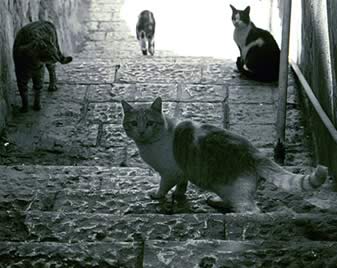
As the owner of two cats myself, one of which makes a determined effort every day to get into church for Mass (and in the summer often succeeds when the outside doors are left open) I always enjoy hearing about Pope Benedict`s liking for cats too. Here is a recent story from Bild.de translated by Chris Gillibrand of the ever informative Catholic Church Conservation blog.


The Pope wanted to write books about those with velvet paws.

In the New Year, Pope Benedict XVI has to cope with a number of appointments, traveling also is ahead of him and he has to write a book and two Encyclicals.


He only very rarely has time for himself. But now he has told his neighbour in the papal apartments, what he would really do, if he just dreams for a couple of moments. Then he thinks of his secret wish:

To write a book about cats.


Secret vocation:


The Pope would like to be the author of cat stories


A cat at the Coliseum in Rome:


The Pope loves the stray animals


As Joseph Ratzinger said in April 2005, following the funeral of his friend, Pope John Paul II, he finally after 24 years in Rome would go back to Germany, because he had a plan: to write stories, stories about cats.


Joseph Ratzinger has had cats around him for decades, not least when he was leader of the Congregation for the Doctrine of the Faith. The Congregation lies on what was once one of the busiest streets of Rome, the Via Aurelia. On this street every day, cats are injured. Not a few of the animals are carried into the garden of the nearby Congregation. There resided Ratzinger, then Cardinal, who took care of moving the cats. He fed them with milk when they were hungry, dressed their wounds, watched as they lay in the sun and slowly recovered. And he gave them all a name.


About these cats, he wanted to write. But his election of Pope stopped these plans. As Pope Benedict XVI, from then on, he had to take care of the great Universal Church instead of the small cats on the Via Aurelia.


The responsibility weighs particularly heavily at present on the 81-year-olds. Bishop Cornelius Korir of Eldoret in Kenya reported today to the Pope on the phone from the battlefield: "They have burnt down a church in which there were 200 people. Children and the elderly were trampled down and burned.


"The Pope does not even take the normal short Christmas holiday in Castel Gandolfo. He worked on without Christmas holidays. In the coming year, he must travel in the United States, Australia, and to Lourdes in France and has to prepare a speech on Monday to the diplomatic corps.


But little has changed in his friendship with the cats of the Vatican.


I park my motorcycle on the way to my office at the Vatican always at the border crossing- the Paul VI Audience Hall. Swiss Guards keep watch there. If previously scattered animals tried to get into the garden of the Vatican, they shooed the animals away.

But when the guardsmen now see a cat, then they let it simply into the beautiful gardens of the Pope. Because they know that Benedict XVI, if he praying in the afternoon at the Grotto of Our Lady of Lourdes in the Vatican, is always pleased when he sees a cat. Because then he returns to his old dream: that he did not want to be Pope, but planned instead to write cat stories.

Friday, January 04, 2008

An alternative world?

No these things are really happening. Here are a couple of encouraging events from the universal Church which came to my notice recently and show what can be done as regards Summorum Pontificum. While in many places it continues to be largely ignored or frustrated here are a couple of bits of good news.

Firstly, Fr Demets of the Priestly Fraternity of St Peter gives a talk to the clergy of the diocese of Little Rock, Arkansas on the Motu Proprio. To hear it click here.

Secondly in Hawaii a bishop and his vicar General sign up for lessons on how to celebrate the 1962 missal. Read about it here.

Sunday, December 30, 2007

Good News about Catholic Education


Moving out of the sanctuary for a while, I was very pleased to see this on the Independent Catholic News site. Congratulations to bishop O`Donoghue and to his chairman of his education committee, the dynamic Fr Luiz Ruscillo. The document can be found here. I sincerely hope it will become a model for the rest of the country.


LANCASTER - 30 December 2007 -


Vatican welcomes Bishop O'Donoghue's Fit For Mission schools document


Bishop Patrick O'Donoghue of Lancaster Diocese(UK) has received the endorsement of the Congregation for Clergy, Rome, for his recent teaching document, 'Fit for Mission? Schools'. The Congregation further express the hope that it will become 'an example for other Dioceses in the country in their implementation of the General Directory for Catechesis and the Catechism of the Catholic Church in their individual ecclesiastical jurisdiction'.


Archbishop Mauro Piacenza, Secretary for the Congregation for Clergy, has sent the Congregation,s congratulations to Bishop Patrick O'Donoghue for his 'courageous examination of the state of evangelisation and catechesis in the diocese of Lancaster's schools and colleges' - among other things, and for developing a positive programme for action in harmony with the General Directory for Catechesis and the other operative Magisterial documents.


Furthermore, Archbishop Mauro Piacenza wrote in his letter of 15 December, 'The Congregation is especially pleased as your pastoral plan is precisely that which was called for in the "General Directory for Catechesis after the release of the "Catechism of the Catholic Church'.


The Dicastery wished the Bishop well in the implementation of the Fit for Mission? Schools programme, which will be developed throughout the diocese during 2008. In the New Year, the diocese,s Education Centre will facilitate and co-ordinate further consultation and implementation of the action plan among primary and secondary schools, and colleges. This will culminate in a diocesan conference in November 2008 to discuss the progress of Fit for Mission? Schools over the year.


Bishop Patrick is most encouraged to receive the support the Congregation for Clergy for Fit for Mission? Schools. He said: "To be honest, I have been overwhelmed by the positive response! Before Christmas, my office was inundated with congratulations, enquiries, and requests for copies of Fit for Mission? Schools from within the diocese, from around the country and internationally".


The Bishop's Office in Lancaster has received requests from the United States, Canada, Australia, France, and Malta.
Source: Lancaster Diocese

Friday, December 28, 2007

New emphasis on exorcism? Vatican denies report

Today the Daily Mail picked up a story from the Petrus website about Benedict XVI asking for special exorism squads. Apparently this became known through an interview with Fr Gabriel Amorth, the official exorcist of the diocese of Rome. It was also on Petrus that an interview appeared with Leo Darroch, the new head of Una Voce, which attributed to him all kinds of things he never said. Seems as if Petrus is not that reliable as a source of news. Catholic World News has the announcement about the Vatican rejection of the story.

New Ecclesia Dei document

Today the Catholic News Service gives a summary of Pope Benedict`s plans for 2008. Among them are the new document from the Ecclesia Dei comission which will clarify questions that have arisen over Summorum Pontificum. When a document comes out from a Vatican congregation sometimes hair-splitters who don`t like what the document says will say that it is a document of low authority because it is not the work of the Pope but a Vatican department and so it effectively gets ignored. A document from a congregation can acquire greater authority if it is signed by the Pope himself in forma specifica. The good news from the Catholic News Service is that this appears to be what is going to happen. Here is the relevant paragraph.

Sometime early in the year, the Pontifical Commission "Ecclesia Dei" plans to issue a document clarifying questions that have arisen regarding the pope's 2007 document relaxing restrictions on use of the Tridentine Mass. Sources said the pope personally is interested in removing ambiguities, and will sign off on the new document.

I have great hopes for this document as there appear to be cases where the Motu Proprio is being ignored or misinterpreted to prevent a more ready access to the 1962 missal for those who request it and various specious excuses are put forward to block access. Sometimes it is said that a Mass can only happen if the people requesting it are from that particular parish but then on the other hand when people from a parish have made a request they have been told that they can`t have it because there is already provision about twenty miles away in another parish. Let`s hope this new document will clear up some of the recent obstacles.

Wednesday, December 26, 2007

The exotic liturgical life of Bensham


On the fourth Sunday of Advent the Society of St Pius X, who have celebrated the traditional Mass on a Sunday in the Station Hotel in Newcastle for the last 34 years (with a short inter-regnum when they had an independent, ex-SSPX priest, Fr Glover), moved into their new home the former Anglican church of Christ Church in Bensham, in Gateshead. I include a picture here of this fine church and a link to more. I went to this church in 2005 for a Christian Unity service for Gateshead led by the bishop of Durham, Tom Wright who spoke a lot of sense about ecumenism on that occasion. I was invited back for a sneak preview of the church a couple of weeks ago. The Society had originally planned to take over another ex-Anglican church in the Bensham area of Gateshead, the lovely church of St Cuthbert on Bensham Bank, but found the costs prohibitive. That church has now been acquired by an Orthodox group so Bensham will be able to provide quite a wide variety of liturgical experience!


The new SSPX church has had it`s name changed to the church of the Holy Name. When I was parish priest of St Wilfrid`s and St Joseph`s in Gateshead ( with a weekly Sunday indult Mass) I heard that the SSPX were planning to move into the town. They often complain that bishops set up officially sanctioned celebrations of the Tridentine Mass only where their own churches exist. Having a Tridentine Mass with an attendance of 80 or so I felt that they were setting up near to me. However there is no sign of the SSPX opening up in Forest Hall as yet! Meanwhile the Sunday 12 noon EF Mass continues at the nearby St Joseph`s, Gateshead.


There is talk of the excommunications of the SSPX bishops being lifted soon. If this happens then we will have another church on Tyneside where Catholics may freely worship according to the EF. A field trip to St Cuthbert`s to study the Divine Liturgy of St John Chrysostom should also be a possibility it seems!
I should also mention that Bensham is the home to a large Orthodox Jewish community with one of the most important yeshivas (Talmudic school) in Europe and that the SSPX is right in the centre of it.

More encouraging news from the Vatican


This story appears today on Catholic News Service regarding the recent changes in the papal liturgies. It`s interesting to hear what the new papal MC has to say about these changes. Let`s hope this outbreak of sanity continues and that maybe something will hapen to the papal chasubles too. So far the Pope has turned out in some good copes but the chasubles appear to be the same cut as those of John Paul II although without the `fly-away` orpheries. I hope 2008 brings a papal celebration of the EF. It would help those of us in the trenches who are trying to promote Summorum Pontificum in the face of indifference and hostility.